
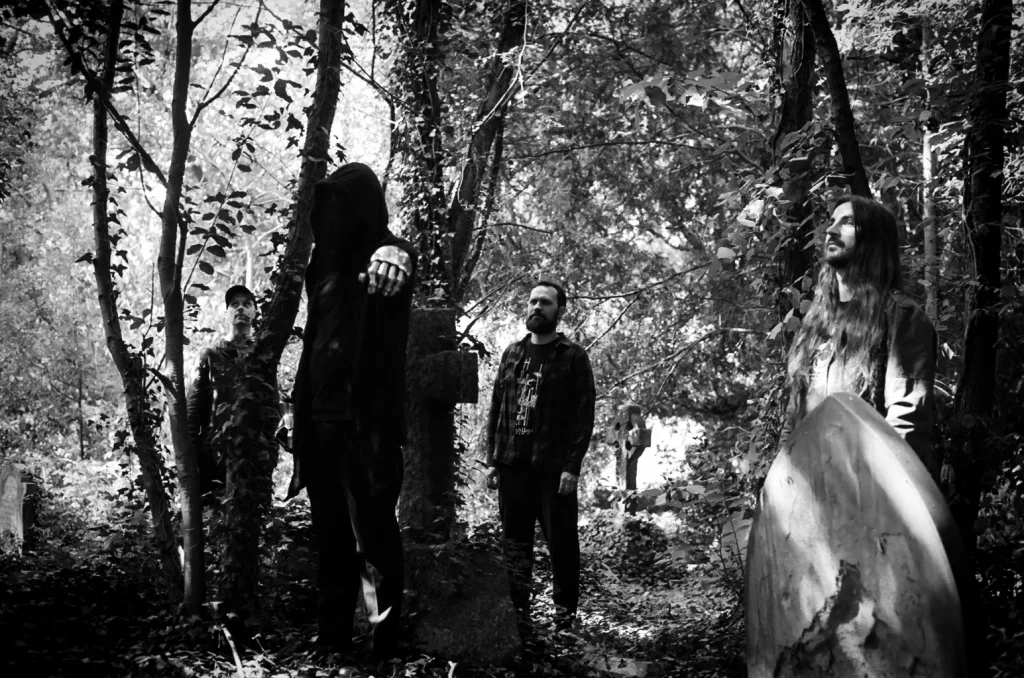

With their debut full-length album Failing Light, DROMOS continue to refine a vision rooted in the immersive depths of funeral doom. Drawing on backgrounds that span death metal, industrial, and experimental heavy music, the band crafts a sound defined not only by weight, but by atmosphere, patience, and emotional resonance. We spoke with Sami, Patrick, and Matt about the album’s creation, the role of melancholy and repetition in their music, and the balance between tradition and exploration within the doom landscape.
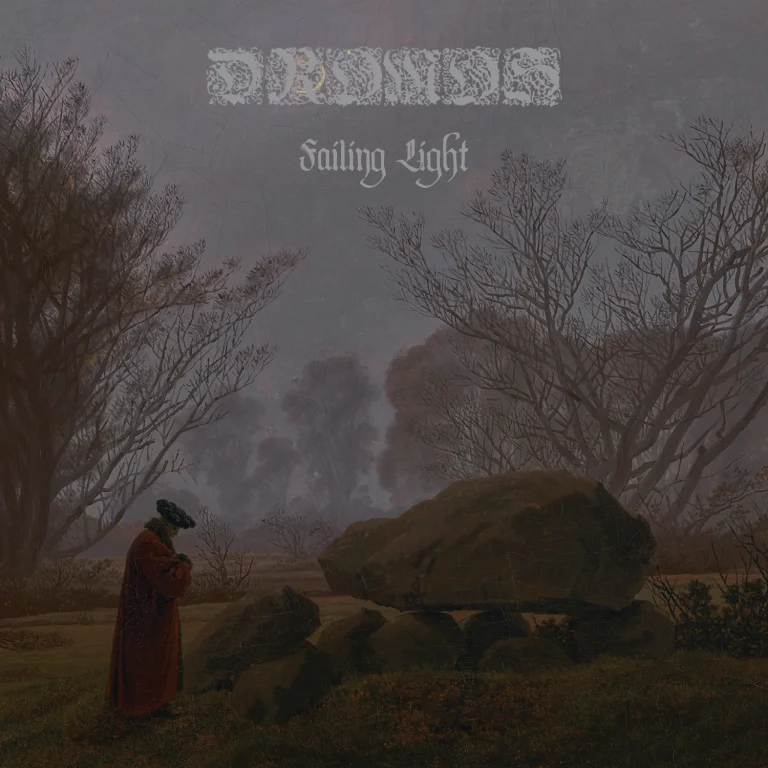
Hi! When Failing Light began taking shape, what kind of atmosphere or internal state did you feel the album was trying to sustain from beginning to end?
The overall atmosphere of Failing Light follows the path established on the EP and will likely continue into our next material. It embraces many of the characteristics that define funeral doom as a genre: music rooted in sorrow and introspective contemplation. The songs aim to express this not only through riffs, but also through progression, pacing, and dynamics. The intention is melancholy rather than despair, reflecting the idea that sadness is an unavoidable part of life, but not necessarily its final destination, as funeral doom can be felt as uplifting music too. At the end, the album’s emotional impact remains fluid, shaped by the listener’s state of mind. Even for those who created it, the feelings evoked by the music will likely continue to evolve with each return over the years. – Patrick
A lot of funeral doom relies on sheer weight, but DROMOS also leans heavily into immersion and spatial depth – when writing, are you thinking more in terms of riffs or environments?
In funeral doom, riffs and atmosphere are inseparable. As a genre deeply rooted in emotion, the environment created by a piece of music grows naturally from the riffs themselves rather than being added afterwards. Heavy passages alone are not enough; the riffs should guide the listener through a journey rather than simply serve as a platform for vocals. The focus has always been on writing memorable riffs, sometimes simple, but never generic. – Patrick
Having played in projects like Grave Miasma, Final Dose, Mutagenic Host, and Eihort, did DROMOS emerge as a reaction against the immediacy and aggression of those bands, or as a continuation of the same atmosphere through slower and more immersive means?
We wouldn’t say Dromos is a reaction against the music we play in other bands. Dromos emerged more from a place of inspiration, influence and desire to do our spin on the music genre – doom – we’ve all been listening to for a long time. There are certainly adjacent elements in there with the music being heavy and dark in the feel of it. – Sami
The band carries connections to scenes rooted in death metal, industrial, and more experimental forms of heavy music. What aspects of those backgrounds still consciously survive inside DROMOS?
Weightness, immersiveness and somberness. – Sami
The pacing in funeral doom can either feel hypnotic or stagnant depending on execution. What tells you a slow passage is truly evolving rather than simply lingering?
Perhaps it’s a sense of losing sense of time. A slow passage is evolving when you stop thinking about the tempo or the length of the track. Instead of just lingering on a heavy riff, the song actually feels like a journey. It circles back to that idea of being transported, the progression is immersive taking you to a different place. – Sami
Compared to your 2024 debut EP, what expanded the most on Failing Light: confidence, sonic vocabulary, or compositional patience?
Failing Light feels more introspective and patient with its longer songs, a bit less death-doomey whilst still being a heavy piece of music. Because there’s more room in the songs for exploration, we were able to expand our vocabulary bringing in more layers like synths, acoustic guitars and different vocal styles to support the overall shape and feel. – Sami
The music often feels cinematic, but not in a polished or orchestrated sense – it’s more like being trapped inside an environment. Is visual imagination important during composition?
The imagination exercise that you mention, for us, is more towards trying to anticipate emotions rather than by specific imagery. During the writing stage, the focus is on the feelings a song is meant to convey, and that has to start with the riffs themselves. As the composition develops, that emotional foundation expands into a broader atmosphere shaped by the instrumentation, vocals, and lyrics. Studio production also plays an important role, as certain sonic textures and spaces can reinforce the intended mood. While writing and imagining those atmospheres, there is often an attempt to place oneself in the listener’s position and consider how certain passages, dynamics, and moods might be experienced by an audience. – Patrick
Did signing with Argonauta Records change anything about your mindset going into this album, or did you consciously try to protect the project from external expectations?
The album was finished before we signed with Argonauta Records and we didn’t have any external expectations to meet. We’ve generally not had any constraints or pressure from outside – both our releases have been written with full creative freedom. – Sami
A lot of extreme music aims for confrontation, but DROMOS feels more absorptive and consuming. Do you think of the listener as being challenged, overwhelmed, or transported?
We lean more toward immersive and reflective. That’s especially prominent on Failing Light because the longer song structures naturally lend themselves to that. If we had to pick from your three words, ‘transported’ fits best. We didn’t actually set out with an active goal to transport people to a certain space or force a specific feeling but if the atmosphere of the album ends up doing that organically, then that’s a great outcome. – Sami
With members coming from more aggressive and immediate styles of underground music, did slowing everything down require a different kind of discipline creatively?
Playing slow music is sometimes surprisingly difficult and becomes more of an exercise of restraint and memory. The long notes and passages can be unforgiving especially when played live. For example the feel of how hard you pick a string becomes more prominent, speeding up can lose the tension and impact the heaviness of the music. – Sami
There’s often a ritualistic feeling in the repetition and progression of the material. Is repetition something you view structurally, emotionally, or almost physically?
All of the above, really. Repetition definitely brings structure but I can also be what makes the music feel physically heavy. When you lock into a progression and just let it repeat and build, it stops being just a riff and starts becoming an emotional, hypnotic experience. Like you said, it becomes ritualistic drawing the listener in. – Sami
How important is silence, or near silence, in music this heavy?
It tends to give the music more space to breathe. There’s a balance where just enough breaks and near-silence supports the music and makes the heavier parts feel even heavier, we find, without losing momentum. – Sami
As DROMOS becomes more visible through events like DesertFest London, do you feel connected to the traditional doom lineage, or more aligned with the experimental fringes of heavy music?
Not to equivocate too much, but the connection is clearly there on both sides – obviously we’re an offshoot of the family tree that comes from Sabbath, Vitus, down through Skepticism, Asunder and so on, but we don’t have any particular interest in being a pure genre-exercise; where the listener knows exactly what they’re going to get as soon as they pick up the album, or a band that sounds exactly like another band.
Since you’ve brought up Desertfest, we shared the bill with a couple of cracking ‘straight-up’ metal bands – Smouldering Tomb and Coffin Mulch – as well as a couple more outre acts in IAN and Liquid Shit. It felt like we fit in pretty comfortably there, so perhaps that’s the answer to the question. – Matt
When someone finishes listening to Failing Light, what emotional or psychological residue do you hope remains after the final moments fade out? Thank you!
We hope people are able to immerse themselves to the music in this often hectic world with a short attention span. We appreciate our music may require some patience, with layers opening up even more with multiple listens. There’s a lot of darker lyrical themes on the album; burden of past actions, regret, loss and isolation. The connection between the mind and the body, the feeling of collapse with a glimmer of hope. – Sami
https://dromosdoom.bandcamp.com/music
https://www.instagram.com/dromosdoom/
https://www.facebook.com/dromosdoom
Share: