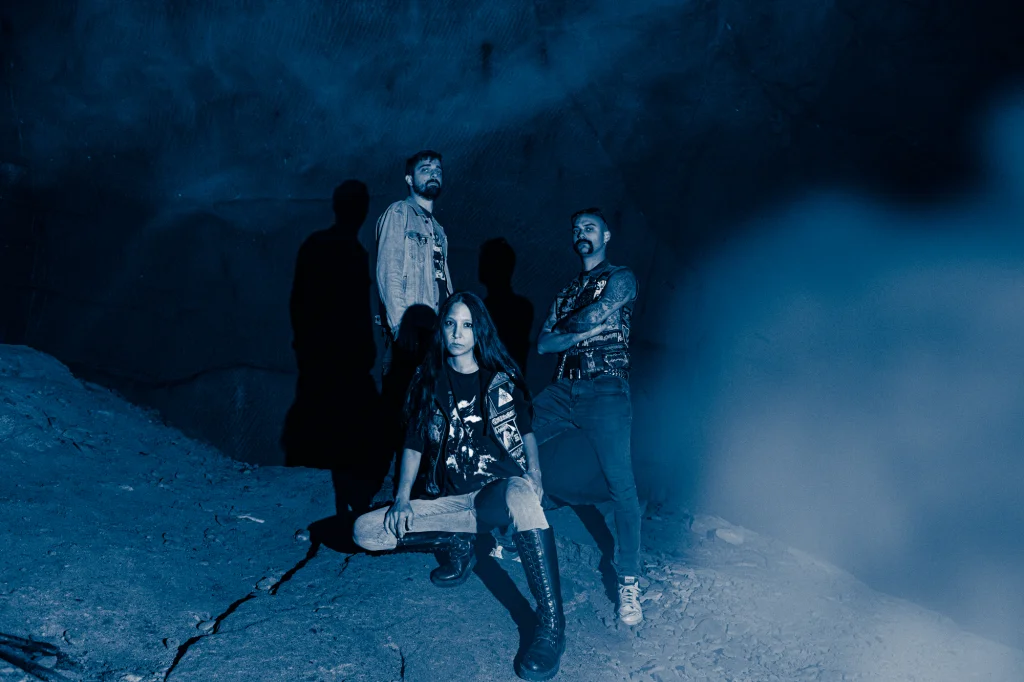

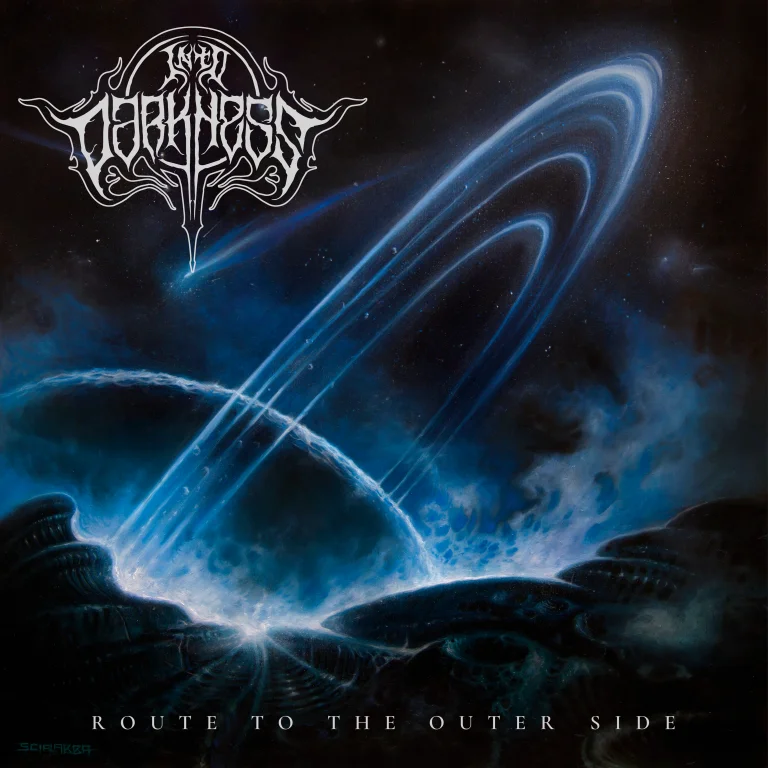
Hail! INTO DARKNESS spent well over a decade releasing demos, splits and EPs before finally committing to a full-length. In underground death metal, that can either mean obsessive self-editing or endless self-sabotage. Which one was closer to the truth in your case?
Hello, and thank you for hosting Into Darkness once again on the pages of Antichrist Magazine. To prepare for writing our first full-length album, I needed to stay focused, motivated, and in a highly creative state, both from a songwriting and a technical perspective. Still, I wouldn’t call it self-sabotage or self-editing. I just needed to find the perfect moment to start, and we went on pretty fast – the songwriting process took us ten months or so, from August 2025 to May 2026.
Your devotion to classic Dutch death metal is refreshingly unapologetic, but Route to the Other Side doesn’t feel like simple scene archaeology. At what point did you realize you were building something beyond “playing records you love correctly”?
The moment I realized we were really taking such a huge step came near the end of the songwriting process. I was spending day and night with my guitar, sitting at the desk in my record room, surrounded by sheets of paper, completely immersed in an overwhelming creative process. It was the best and, at the same time, the worst period of my life.
During those months, I was working mainly with Santo, our drummer, bringing tons of riffs and song ideas to rehearsals so we could arrange the drum parts, which I already had a pretty clear vision of in my head. Working with him was a fundamental part of the whole process, and together we improved both our skills and our workflow tremendously.
The Dutch influence list is serious business – Asphyx, Soulburn, Pentacle, early Sinister, Gorefest, Dead Head, Phlebotomized… these are bands sharing geography more than a single formula. What exactly attracts INTO DARKNESS to that particular national strain of death metal? The riff language? The heaviness? The strange balance between brutality and mournful atmosphere?
I can’t really put it into words, but I’d say it’s a combination of factors. Dutch Death Metal is unique to me, full of diverse influences and rooted in a variety of earlier styles. You’ll hardly find two Dutch Death Metal bands that sound alike.
I’d say I love Dutch Death Metal because it reflects everything I enjoy playing and hearing in music: dynamic, original, colorful, and vibrant songs that never stop amazing me. I’m also deeply into American Death and Thrash Metal, and that’s definitely something many Dutch Death Metal bands have drawn inspiration from.
Death metal has exhausted nearly every cosmic cliché imaginable – aliens, voids, Lovecraft, cyber-nightmares, pseudo-occult nonsense. INTO DARKNESS took a very stubborn route: actual astronomy. How did you arrive at the decision that scientific reality was more compelling than fantasy?
It hasn’t really been a choice between two topics, or “science” versus “fiction” or anything like that. I simply thought astronomy would be an original subject to write about. It’s been a passion of mine ever since I was a kid.
Even though I enjoy writing lyrics and consider myself fairly good at it, I doubt I’d be as effective or expressive writing about personal feelings and inner struggles. In my opinion, I wouldn’t even be that good at writing about the usual “metal” topics – Satanism, gore, and so on. Maybe I could write about medical subjects, since I work in dentistry and have always been passionate about human anatomy and biology.
I see myself more as a “concept” writer, someone who likes to build everything around a central theme. And last but not least, I believe the sound of the words, the rhythm, the meter – in short, the overall aesthetic of a lyric – is often more important than its literal meaning. The voice is another instrument, and it deserves to be treated as such.
Staying on that – does your lyrical approach require genuine research discipline, or are you consciously allowing poetic license to contaminate the science from time to time?Sometimes, when it’s needed. As I said in the previous answer, it’s more about the aesthetic of what you’re singing and how it fits the music. But astronomy isn’t all that original as a lyrical topic, and the scientific way of describing planets, stars, and satellites can be more or less the same formula.
That’s where poetic license comes in, so to speak. The subject remains scientific, but it’s enriched with poetic imagery, and I really like that balance.
Pluto surviving as a planet within the album’s conceptual universe feels almost wonderfully rebellious. Scientific insubordination? Childhood loyalty? Or simply refusal to accept bureaucratic astronomy?
Childhood loyalty, definitely. I still remember how shocked – in a positive way – I was when Eris was discovered and when Pluto was reclassified. I took the liberty of taking the listener on a journey through that region of the Solar System, while also offering a glimpse into the past, as if we were still living in the ’90s or the early 2000s.
There’s an interesting contradiction inside Route to the Other Side: the subject matter deals with incomprehensible cosmic scale, yet musically the album remains grounded in very physical, earthy, riff-driven death metal rather than “space atmosphere” shortcuts. Did you deliberately avoid obvious sonic signifiers of cosmic music?
Yes. The two things go on together in parallel on different tracks: music it’s music, lyrics are lyrics. I like Death Metal, I like to play music, and I have a pretty clear vision on how I like the music I write to sound. I could enrich or contaminate it in a different way that would match better with the music, but why? You’ll find samples every now and then – The “Cassini – Huygens” EP is full of those – but Into Darkness is still a Death Metal band, and I don’t want it to sound different. I like coherence, but I don’t blame those who choose different paths in music. The thing is: do what you like, express yourself and what’s inside of you and don’t pretend to be or to do what you’re not.
Modern old-school death metal often suffers from a strange problem: bands know the correct records, correct guitar tone, correct logo aesthetics – yet somehow forget memorable songwriting. When writing INTO DARKNESS material, what usually matters more: atmosphere, riff economy, narrative flow, or pure instinctive headbanging logic?
When it comes to songwriting, there’s a basic question I first ask to myself: is this riff memorable? Does it fit with the rest of the song or is it unuseful? Is it recognizable, is it effective? Would you buy and fall in love with a record that sounds this way?
Speaking about the last decade, songwriting became crucially fundamental to me. While composing “Route to the Outer Side”, I spent every single free moment I had, after work, after rehearsals, during the weekend, forcing myself to sit down on the chair of my music room writing and playing, on and on. When I was not isolated in the record room, like while getting to work, I was listening to all the albums I take inspiration from – records that I know note by note – to catch that secret, that atmosphere, that pattern in order to get my own mental flow that gives life to a good songwriting.
Every musician is different from each other, and there are many ways to write a little masterpiece, but that depends especially by the writer’s tastes in music and his/her sensitivity – and skills, sometimes.
Italy has always had its own peculiar death metal undercurrent – less globally mythologized than Sweden or Finland, but full of stubborn cult acts and bizarre mutations. How do you view the current Italian underground from the inside? Healthy ecosystem, oversaturated revivalism, or something in between?
I think the Italian scene today is very fragmented, uneven, and strongly regional, both when it comes to bands and fans. I didn’t experience the ’90s or the early 2000s – I started going to shows and playing in bands in 2008. I remember I was traveling a lot; every weekend I was either at an underground gig or playing with my band. At those shows I would meet people who, just like me, would drive for hours or take long train rides (and then sleep at the venue !!!) just to be part of what a concert represented: belonging to something, supporting the bands, buying records, having fun, getting drunk, and meeting people that you’d share your same passion with.
Even though the musical divisions between subgenres were very clear, I would meet the same people at a Death Metal show that I had seen at a Thrash Metal gig, and so on. I knew pretty much everyone. There was definitely a lot of hostility toward younger metalheads, but it was never really a problem because there were so many of us, from my same generation.
Nowadays it’s difficult to organize a show while keeping costs affordable for everyone. Fuel is expensive, and people are struggling financially. The record market also seems to be in a bad state here. People travel less and buy fewer records. I’ve even considered organizing shows for friends’ bands that live on the other side of the country, but believe me, it’s simply not economically doable. As a result, it’s much harder to bring together a diverse audience and maintain a cohesive scene across the country.
Also, yes, especially people who are older than me often seem not interested in new bands from their own country. They’ll buy demos from completely unknown bands on the other side of the world, but they won’t pay attention to young Italian acts. I think that’s a serious mistake on their part, and I’m afraid we’ll all end up paying the price for it.
After operating since 2011, you’ve witnessed several cycles of “old-school death metal revival”. From your perspective, what has changed most in underground DM culture – better musicianship, stronger global networking, collector obsession, social media dilution…?
I strongly disapprove of the immediacy of social media. I also dislike how easily today’s platforms allow anyone to become someone simply because they have a place where they can do something. Talent is innate, and finding what’s worth of attention or not has become increasingly difficult in such a saturated scene. The underground is full of noise, and much of it is unnecessary.
When I started playing in bands, I worked hard burning promo CDs at home, stood in long lines at the post office to mail them to labels, and exchanged letters with countless people. I would discover new bands through a flyer, a gig, or the thank-you section in a record’s liner notes. The truth is simple: there are so many of us now, and social media has blurred the line between what really matters and what is merely image.
Better musicianship? I don’t think so. I don’t know many of the newer bands that have emerged over the last ten years, but I do notice that the trend seems to be focused more on chasing a specific sound – something dark, evil, and heavily down-tuned – than on the impact of the riff itself. I rarely hear memorable riffs from many new bands. I rarely hear guitar solos.
If tuning your guitar down three or four steps is what makes your band worth listening to, then something is wrong. I tune down one whole step. What I write will sound like Death Metal whether I tune down one step or three. You be the judge.
The production on Route to the Other Side sounds strong without collapsing into modern hyper-clean sterility. Was achieving that balance difficult? Death metal engineers today often seem terrified of leaving anything slightly dangerous, dirty or imperfect in the final mix.
It wasn’t difficult at all. Carlo Meroni (ADSR Decibel), my sound engineer, thinks and works much the same way I do, so to speak. In my case, he completely embraced the band’s vision and sound. He knows me better than anyone else. The connection between us is so important that I can hardly imagine ever recording with another sound engineer.
We’re both rooted in the Old School, yet still influenced by non-metal music, open to new challenges, and deeply sensitive and emotional by nature. I can’t speak for him, but every time I walk into ADSR Decibel Studios, I feel like I’m taking another step forward in my musical growth, my technical skills, and my connection to music. It’s a fully immersive odyssey into music.
The secret, to me, is to record the way you’ll sound live. Bring your amp head, your guitar, your pedalboard, or whatever you use, and play exactly the way you’re going to on stage. A band should be able to faithfully reproduce what people hear on the record.
Teitanblood just came to mind. As far as I know, they don’t want to play live because they believe they’d struggle to recreate on stage what people hear on their records. Fair enough!
Your lineup titles – Pilot, Mission Specialist, Commander – could easily become gimmicky in lesser hands, yet they somehow fit your thematic discipline. Was that born out of humour, conceptual commitment, or simply spending too many nights staring at astronomy material?
Hahaha, good one! While I was writing this album, I felt more alone than ever, but I was still surrounded by people who, in one way or another, helped shape my vision until the very end. They all had different roles, but they’re all friends of mine, so I felt we were a team working together to make this album the best it could possibly be. I’m grateful for their help, and especially for their never-ending support.
A scene-authentic question: what still gives you genuine excitement as underground death metal listeners in 2026? New bands? Ancient demos resurfacing? Tiny distros? Obscure regional scenes? Or has the constant flood of releases made discovery harder to truly enjoy?
Hard to say. It depends on how old you are, how many years you spent in the scene, what you’re searching for in music and the amount and variety of music you listen to. I think there should be a balance between keeping the roots alive – digging into old demos, classic records, and forgotten underground gems – and supporting the new bands that deserve attention. I can’t really talk about innovation, because it’s always been a difficult subject for me. I never forget my roots – or rather, I live through my roots in music!!! – but I’m also aware that supporting new bands is the only way to keep the underground, and metal music in general, alive. The old, legendary bands will be done in twenty years. And then?
We also can’t ignore the fact that social media has completely changed the rules of the game. My little contribution is to keep on listening to music, buying records, sharing my passion with other people like me, supporting the underground as much as I can and leading my band the best way I know how.
You’ve carried this bad through lineup changes, long gaps and underground time-dilation before reaching the debut album stage. Looking back honestly – was there ever a moment when INTO DARKNESS was close to becoming another unfinished cult footnote buried in demo archives?
Maybe that happened right after the “First Encounters” demo. I didn’t have a line-up back then, but I was still determined to get back on my feet and kick my own ass into finding people to play with. It’s not like I’ve ever spent a whole year without playing in a band, but your main band will always matter more than anything else … won’t it?
Final question – if an old Dutch death metal purist hears Route to the Other Side and says: “Good record… but too Italian”. Would you take that as criticism, misunderstanding, or perhaps the highest compliment possible?
I wouldn’t really understand the “too Italian” comment, but I can’t know what people feel when they listen to a record. Music reaches your ears, but you hear it with your heart. That’s not something I can judge. The greatest compliment anyone could give us would be: “I listened to their previous records, and this one captures everything the band stands for – their identity, their sound, their way of writing – and it’s their strongest album so far.”
And one last thing: “Route to the Other Side” sounds more like a classic Dutch Death Metal record than many albums released by the old Dutch bands themselves these days. I’m incredibly proud of what we’ve created. This album is exactly what we wanted it to be, and if this is the path we’re on, I can’t wait to get back into the studio and see where it takes us next.
http://facebook.com/intodarkness
Share: