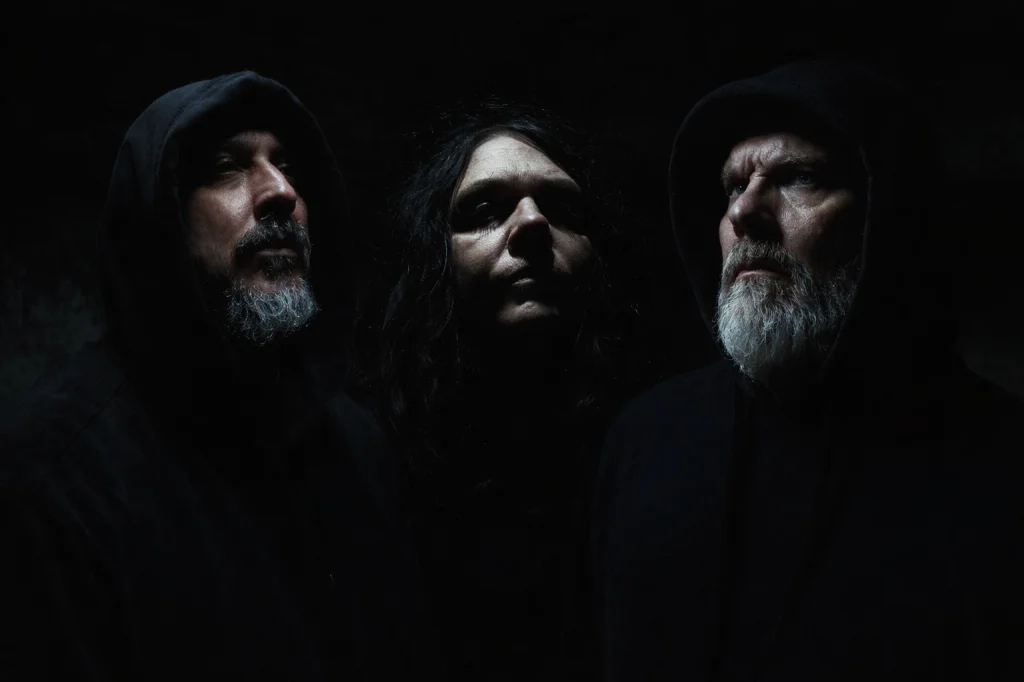
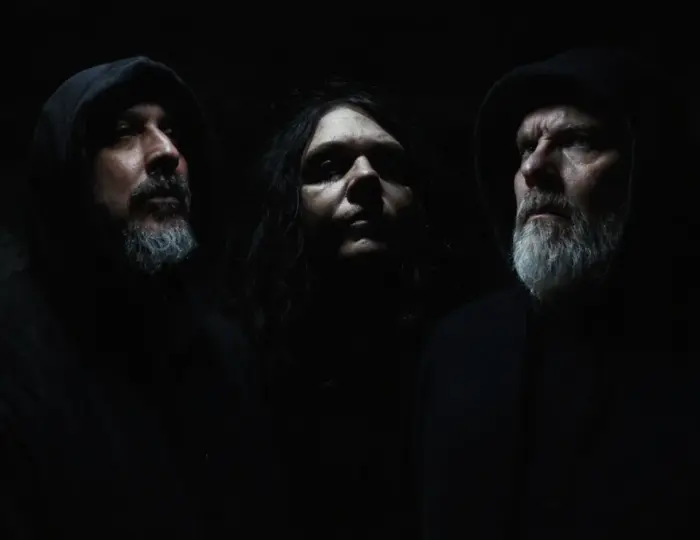

Dead Sleep return with a sharper, more stripped-down attack on Repulsion, an EP that trades ornamentation for instinct and discomfort. In this conversation, Anna Wagner talks about moving away from metal clichés, embracing a more primitive sound, and why authenticity – not image – remains the only thing that actually matters.
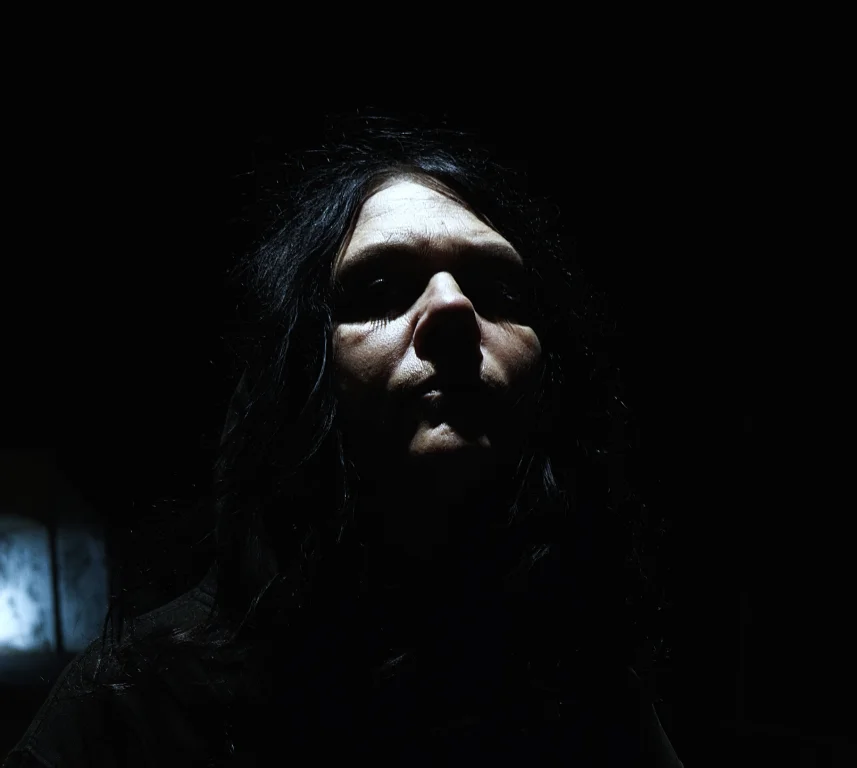
Hi there! Compared to your earlier material, Repulsion feels uglier in a very deliberate way. Did you consciously want the EP to hit harder emotionally rather than just faster or heavier?
Yes, we deliberately wanted to go for a darker and more sinister direction this time, both lyrically and soundwise. Our new format as a trio also means that we have to “cut the frills” and not make ourselves too dependent on fancy solos and stuff that we can’t reproduce in a live setting. So we tuned down our instruments and have tried to find a more instinctual, primitive attack in our songs.
There’s a strong thread of defiance running through these songs, but it never turns into slogans or easy empowerment. Was avoiding that simplicity important to you?
If there is one thing I personally am totally bored with in lyrics, it is when cliches are used lazily and without deliberation. Just resorting to the over-used symbols of death and destruction, like skulls, corpses and blood, in the end these just end up being empty words. But when you start to think about the real implications of death and war, you end up in more personal territory: loss, fear, madness, desperation, abandonment – clearly in the emotional sphere and often an area that is heavily guarded within the depths ourselves. We need to lift that lid if we want to find out more about the mysteries of life and death. And these feelings often turn out to be very complex, contradictory and not easily reduced into slogans.
Lilith and other historical or mythical women appear almost like shadows across the EP. What drew you toward those figures specifically?
Well, I think that metal has always been a boys’ club and has systematically ignored the female experience and has only focused on the symbolism of man as a harbinger of death and destruction. That does leave a large portion of the human experience undiscovered and there is a rich tradition of female characters in both fiction and history that have gone against the church (or even God in the case of Lilith) and transgressed their assigned gender roles as mothers and nurturers through sometimes killing for revenge, for vanity, for convenience – and I think these characters are very interesting to explore.
A lot of thrash still leans on aggression as performance, while Repulsion feels more personal and confrontational. Did the writing come from a different headspace this time?
As previously mentioned, our music has changed a bit since becoming a threepiece. Even though we still have thrash at our center, we have let ourselves be influenced by other genres, like first wave black metal, to channel a more instinctual and primitive approach. And lyrically, our last two albums dealt with the outside world: capitalism and the overtaking of our corporate-driven world by “naked tyrants” such as Trump etc. Thematically we wanted to go inward this time, so we don’t become too much of a cliché ourselves!
The EP sounds raw without feeling nostalgic about being raw. Do you think old-school metal sometimes becomes too obsessed with recreating the past instead of using that energy for something new?
Absolutely. There are many tropes you can use to fit into a neat musical label, but where is the fun in that? I don’t think being nostalgic is necessarily a bad thing, but I think we could allow ourselves to trust our instincts a little more. Letting our music be tarnished by all the grit we have lived through will only make the music more personal and give it a reason to exist.
As a trio, the band sounds meaner and more direct now. Did stripping things down make the music feel more exposed?
In a way it does. To a certain extent one has to compensate for the lack of a second guitar through being even more ferocious in one’s playing. So it’s a little more naked, not so much to hide behind. But the trio format also helps us be distinct and tight.
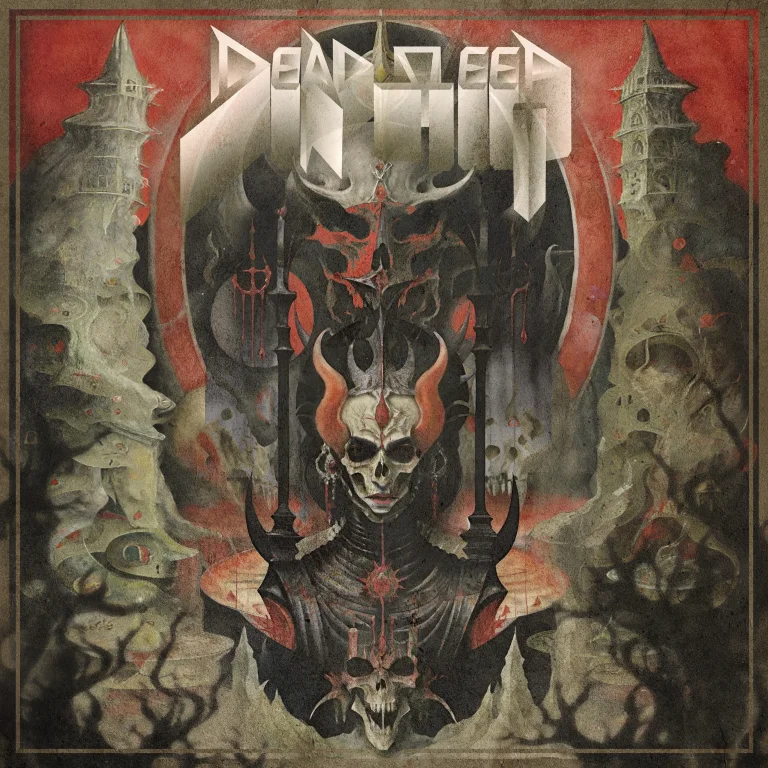
There’s a punk attitude in Dead Sleep that feels instinctive rather than aesthetic. Do you still feel connected to punk as a mindset, or mostly as an energy source?
Speaking only for myself, I will probably always be a punk at heart. For me punk means freedom of expression rather than being a perfect musician. So yes, I guess it’s part of a Dead Sleep mindset and not only something that is used as a source of energy.
The title Repulsion can mean disgust, rejection, resistance, even attraction pushed too far. What did that word hold for you when it became the center of the EP?
It’s a powerful word. Marcus named the track originally, even before the lyrics were written. As you mention, it is a word that contains contradictions in itself, which makes it a more interesting word than for instance “hate”. It’s a feeling that connects to our physical instincts rather than the intellect, a subliminal impulse that we don’t necessarily have control over.
A lot of underground metal still struggles with how women are perceived once they stop fitting expected roles. Did writing these lyrics feel confrontational, cathartic, or just brutally honest?
As you mention, women have mainly been described as very one-dimensional characters in metal music, they are either victims of male violence or simply sex objects. So I think any lyrics describing women as anything else, like strong individuals with agency and their own convictions and selfish desires, will be a bit confrontational against the status quo. And yes, that is a very cathartic thing, to try to understand these vilified women and channel them and their experiences through music.
There’s a feeling throughout the EP that anger is being used as survival rather than spectacle. Do you think heavy music sometimes forgets the difference?
Yes, I think anger in metal often is performative. And it just doesn’t hit as hard. If you don’t have anything to be angry about, why are you screaming your lungs out? Don’t get me wrong, I think most of us HAVE something to be angry about – I mean, just look at the world – but you need to tap into that emotion for it to come across as valid and not just a pose.
The underground metal scene often romanticizes rebellion while still policing who gets accepted. Have you felt that contradiction personally as a band?
Our band has never really been accepted in the metal community for various reasons, so yes I know what you mean. On the other hand, we are snobs too, and wouldn’t be caught dead playing with certain bands, so I just think it’s probably one of those things within the extreme metal scene. It goes with the territory, since it’s such a competitive field – fraught with the double heavy burden of having to be authentic AND technically well played. There are an awful amount of rules around a genre that pretends to be about rebellion.
At this point, what matters more to Dead Sleep: sounding authentic to yourselves, or sounding dangerous to everyone else? Thank you!
Haha, that is a bit of a leading question – of course it is more important to feel authentic. I think there are many bands out there that might do a good job of sounding dangerous, but there is only one band that can sound like Dead Sleep, so we better keep at it!
https://deadsleepmalmo.bandcamp.com/music

Share: