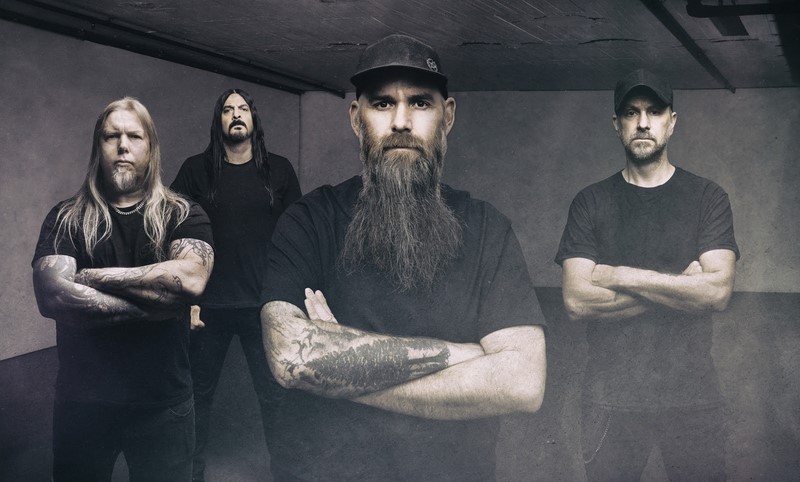
We spoke with Fimbul Winter, the Swedish Death Metal force formed by former Amon Amarth members, about their forthcoming debut EP What Once Was.

Hi guys! That reunion around Arrival of the Fimbul Winter – when did it stop being nostalgia and start feeling like a new band?
Fredrik: Hello! Actually pretty early on. We’ve been friends for ages but never played all together so after a couple of rehearsals we did feel we had so much fun doing it and being ”a band” together we started talking about trying some original ideas.
You’ve called this “unfinished business.” What exactly was left hanging back then that you want to finish now?
F: Well, maybe it shouldn’t be taken literally, but we definitely feel we have more to give within this genre and that our musical ideas never really got to be heard the way we would have preferred.
The name Fimbul Winter has mythological weight, but also history in metal circles. Why claim it as your own?
F: The name is taken from our background in Amon Amarth, from the demo ”The Arrival Of The Fimbul Winter” which Niko and Anders played on back in the early 90’s. I also used to play those songs in the late 90’s when I joined Amon. Those are the songs that connect us and in a way define us. We absolutely had never heard of any other bands with that name when we decided what to call ourselves sometime in 2023 and when I looked it up on Metal Archives there were a few but all disbanded or not active since years.
Why wouldn’t we claim it as our own?
Some riffs go back to the early ’90s. Did they still feel alive when you picked them up again, or did you have to break them apart and rebuild?
F: Some did, some matured in a natural way once we started putting them in a song and working on it, but all ideas felt very much alive.
You were there when Swedish death metal was still raw and undefined. What do people today usually get wrong about that era?
F: That it was bigger than it was maybe. Sure the underground movement was more vivid, sometimes with multiple shows to choose from to visit every weekend. And the shows were packed, but small. Between 150-300 people on regular club shows and up to maybe 1000-1500 on the bigger international bands. But the metal genre as a whole is much huger now. Absolutely no-one, not even the Entombed guys, would ever dream that there would one day be a death metal band playing arenas.
Clint wasn’t part of your past. What did he bring into the room that you didn’t even know you were missing?
F: He wasn’t and yet he was in a way. We met through the old Amon Amarth sub forum on Ultimate Metal where he was a big fan of the old school stuff. Later when we toured we met in person and he’s become a great friend to all three of us during the years. We knew he was the right guy for the job, that was never questioned both from his personality but absolutely also for his vocals! And he brings his enthusiasm with him all the time which is inspiring, and I didn’t know I would think that!
Playing old ground can slip into retro worship pretty easily. How do you keep this from being just a throwback?
F: Not playing by the rules. We play old school melodic death metal, but we don’t keep the old ”rules” of what you were allowed to do or not. If we have an idea and it sounds good we keep it.
Was there a moment during the recording where you thought, yes, this is it, this is Fimbul Winter?
F: Yeah absolutely, there were a couple of those moments for me. And it was in the studio I started to hear what would become of some parts and how we could elevate them even further!
Niko – when you sat behind the kit again, how different did it feel from those early Amon Amarth sessions?
N: It was quite a big difference. Today I take it more seriously than I did back then. I consider myself a tighter and better drummer today than I was back then, even though I haven’t played death metal since I quit Amon Amarth, which is 27 years ago counting from when we started Fimbul Winter.
The music hits hard, but the titles hint at solitude, memory, even loss. Where do those layers come from?
F: I would say also the music has layers of melancholy and that stuff so I think it goes through all the elements.
Clint: Memory and loss are due to the fact a close friend of myself who also was a huge Amon Amarth fan lost his life while the songs were getting written. I took it upon myself with the approval of the other guys to write an homage to him.
Tobias on bass is a heavyweight choice. What did he add that you couldn’t have pulled off yourselves?
F: We wanted to have a bass player playing the songs, not a guitarist playing a bass guitar. There’s a difference. And he definitely added his stuff that we would never have come up with
Be honest: did you feel pressure that this debut had to measure up not just to today’s scene, but to your own legacy?
F: More for myself personally, than for anyone else. I didn’t want to release something half-assed. But that is not really specific for this release. I’ve always taken my musicianship seriously and don’t want to ever release anything sub par my own standards.
You’ve known each other for decades. Did coming back together change the way you see each other now?
F: Not for me. I’ve come closer to Niko during the past 10-15 years and consider him one of my closest and best friends now and that didn’t change after we started playing together. Anders and Clint have always been the same kind of people in my mind, and that hasn’t changed a bit.
What Once Was – the title feels almost elegiac. Is it a nod to your past, or a foundation for what’s ahead?
F: You know it’s pretty multi-facetted. It can be a nod to the past that we bring back to life, nostalgia if you will. Who we are and what we come from. But it can also be what we think melodic death metal should be and reflect what we think is missing in today’s scene.
When you played the old songs live again, did it hit you in a way the studio never could – or is recording its own battlefield?
F: It was just a great feeling to play and hear those songs live again. For me personally it was my gateway into Amon Amarth, I first saw them play live in 93-94 when they opened up for Dissection and they played those songs that would later be on the demo that was released. Later on when I joined Amon we did play those songs, but last time was probably around 2005 or so. We probably played them tighter than they were back them, both Niko and Anders are better musicians now than they were in the 90’s, and less booze involved haha.
Do you want people to hear this as a continuation of a story they already know, or as a band with a new identity?
F: We’re absolutely our own identity. But our roots grow deep.
Releasing a debut in 2025 is a different beast than the tape-trading days. Do you care about the streaming economy, or do you ignore all that noise?
F: It’s a necessary evil I guess. I don’t mind people listening on streaming platforms, even if it doesn’t cover the cost of producing the music, that’s fine. If the music is good enough I think people will want our merch and go to our shows. But as new band though the streaming numbers are needed to get requests for live shows as it’s the only way to measure the ”popularity” of the band. Enough people listening, promoters will take notice and realize people actually want to see the band play.
Is there a thread tying all five songs together, or are they each their own world?
C: This isn’t a concept album, we tried to make each song their own being, but the overall string that brings all these songs together is rebirth.
Do you still hear Sweden itself in your sound – the cold, the silence – or is that just a cliché outsiders cling to?
F: It’s not a cliché. From the climate point of view, yes. But musically we have this melancholy in our DNA. If you listen to old Scandinavian folk-music and traditional music it all has this melancholy.
In myth, Fimbul Winter comes before Ragnarok. Is that how you see yourselves – storm-bringers shaking things up? Thank you for your time!
F: Haha, sure why not! We’re the outcasts, the underdogs. And we do things our way, completely. No label, just DYI and put our literal blood sweat and energy into our music. This is as genuine as it gets. And maybe that’s needed in the scene today, maybe it needs a Ragnarök!
Thank you for the interview!
https://www.facebook.com/fimbulwinterswe

Share: