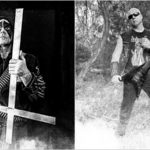


Hi! Volume I set the stage. What new ground does Time to Kill Vol. II break for you?
Volume I opened the doors for us to show our work. Volume II complements everything we wanted to bring to the audience, both musically and ideologically. These songs were written in the same creative wave as Vol. I. With Vol. II we hope to consolidate ourselves as an active band in the Brazilian underground that wants to show its work to the world.
Who or what were you channeling when you wrote this record?
We channeled the collective rage of women resisting in a violent world. We also brought historical references of struggles and female figures who defied the order. The music comes from a place of revolt, but also of strength and memory.
The EP feels violent but also calculated. Do you write from instinct first, or do you build the chaos with a plan in mind?
Instinct comes first — riffs and lyrics emerge from urgency. Then we organize that chaos with intention, thinking about how each part will hit the listener. The result is violent, but not random.
Did anything unusual happen in the studio – a happy accident, a weird technique, or a mistake that made the record better?
Nothing too unusual, except for a lot of laughter. The songs had already been pre-produced by the band before arriving at the studio. Our sound engineer and co-producer, Marcos Pagani from Orbis Studio, captured our essence very well, just as he did on Vol. I.
When Murderess started, what rules did you set for yourselves that you refused to break?
Have fun. That’s our only rule. The world already overloads us with wars, violence and prejudice. The band exists so we can have a moment of relief within all of that.
Pedro came in after the band was already rolling. How did his presence change the way you and Jazz work together?
Pedro helped us shape the band’s identity. Although he joined after the concept was already solid, he brought his creativity to the drums. In the beginning we had guides recorded with guitar, vocals and programmed drums. From the first rehearsal with Pedro, we started changing tempos and dynamics, taking everything to another level — more precise and faster too.
Brazil has its own pulse, musically and politically. Do you feel that sneaking into your riffs or lyrics, even if unintentionally?
Absolutely. We grew up surrounded by inequality, urban violence, and in one of the countries that kills the most women in the world. That naturally appears in our raw riffs, bloody lyrics, and direct way of making metal. But Brazil is also culturally rich, with many different musical expressions. Even if we tried to avoid them, they would still show up in our music. On the contrary, we are proud of our roots and we want to bring them more and more into our way of making metal.
Every band has clashing influences. Can you remember a moment when your ideas collided – and the result turned into something powerful?
Even though we have very diverse influences, we never really had a clash when putting our music into practice. Everyone in the band is very supportive, we admire each other musically, and we want each member’s creativity to flourish to the fullest.
Some groups need years to click. Why do you think Murderess found its voice so fast?
I think in the worst moments of life we find the most precious things in ourselves. For me and Claudia, creating the band was a matter of survival — at the time we didn’t know it, but it saved us. So it was natural to dedicate ourselves fully, and now we’re reaping the results of that effort.
Death metal is still mostly a boys’ club. How do you make sure your voice isn’t just heard, but dominates?
It took us a long time to believe we could have a place in that boys’ club. But once we decided we wanted to do this, we came in without asking for permission, screaming our revolt. Besides, there are a lot of women headbangers who also longed for music dedicated to them, and we always play our shows with our metal princesses in the audience as our first priority.
Gore and destruction are everywhere in the genre. What changes when those same subjects are seen through your eyes?
Our perspective is that of the victim who killed the predator. We talk about death, but it’s not gore for gore’s sake — it’s lyrical vengeance. Violence has political and gender context.
Where’s the sweet spot between honoring death metal’s roots and tearing up the rulebook?
We’re trying not to have a rulebook. Each of us enjoys everything from old-school to avant-garde, with our own preferences. Beyond metal, we also have many references from outside the genre. Our goal as a band is to grow as musicians, and for that we can’t be tied down to just one subgenre.
Murder, war, and violence fuel your lyrics – but you’re clearly not just chasing shock value. What do you actually want people to sit with after hearing them?
We want to show that women can be brutal too — but not without reason. We didn’t create this violent world, but there have always been those who fought back against their oppressors.
Is Murderess an outlet, a fight, or a weapon? Does the answer shift between the rehearsal room and the stage?
It’s all three. In rehearsal, it’s catharsis. On stage, it’s a weapon. In daily life, it’s a constant fight.
Heavy music often feels like survival art. How has writing this EP helped you survive your own battles?
Writing the EP was turning pain into power. Each song is an exorcism of our own wounds and a way to move forward stronger.
Intensity is expected in your genre. Do you ever use silence, pause, or restraint as a weapon of its own?
Without silence, noise wouldn’t have the same impact. I think we all agree we need contrast and dynamics to enrich our music. Opposites are present in life itself — it couldn’t be different in our music.
Picture someone digging up Time to Kill Vol. II 20 years from now. What do you hope they hear in it? Thank you for your time!
I hope it’s another record proving that women were here, as we always have been. For millennia we’ve contributed to world culture and were erased. Today, with technology, it’s easier to register our existence and our relevance.

Share: