
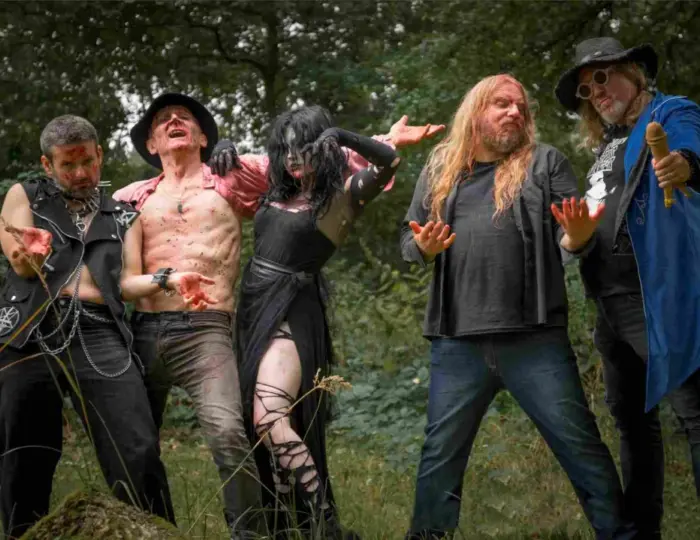
After seven years of silence, Czech legends MASTER’S HAMMER return with Maldorör Disco — a surreal, synth-laden reinvention that dances somewhere between black metal, art rock, and twisted cabaret. Founder Franta Štorm talks about finding freedom in sound, the beauty of bad taste, and why strangeness remains their truest language.
Hello! Maldorör Disco feels very different from your earlier albums. What was happening in the band while you developed this sound?
Hello Melissa, I’m happy to answer these questions for your readers!
Frankly, I can’t describe the inner currents in a rational way. Music is there to hint at what lies beneath. We respond to what inspires us—particularly me: the situation of an artist in a hostile world, how to defend our inner universe of imagination, and finding a safe haven in art. The sound is full of strange analogue synthesizers, but Master’s Hammer’s signature can still be recognised in Honza’s drumming and the vocals from both myself and Necrocock. The new element is Kamil Princ on lead keyboards—he added another layer of a “bad taste”.
Did you have any rules – or perhaps no rules at all – when deciding what this album should be?
I know many artists claim to have no rules, but in the studio they often stick to a tough inner discipline. Personally, I’m a very strict boss to myself, but my relationship to external limiting conventions is quite the opposite. No rules! We also appreciate artists who don’t take themselves too seriously—though not to the point of self-destruction. We love creating with joy, fuelled by humour—not in the sense of self-serving joking, but in the spirit of creative play, with serious content in a deeper layer.
The songs can feel theatrical and unsettling at the same time. Were you thinking about a story, a feeling, or something else entirely when writing them?
Thank you for saying that—it’s much appreciated by an artist! “Unsettling” is certainly our aim, but also “amusing”. The whole story may seem like a deliberate step outside convention. We simply want to take listeners on a journey—like with any other album—but this time the trip is driven by a fresh, danceable tempo of 130 bpm, avoiding any stiff philosophy. The ideas are simple, yet open to multiple interpretations. The lyrics are nicely translated in the booklet so one can get the full picture.
Master’s Hammer has always been “weird” in a way that feels deliberate but unpredictable. How does that tension work for you?
Unpredictable to the point where even we surprise ourselves—the tension comes from the uncertainty of what fans might find interesting. It’s partly intentional, and partly down to the people around us. Kamil, for instance, is from a younger generation—a decadent, half-mad poet, curator, and editor-in-chief of Smrtisyn magazine—he has a very different aesthetic. While composing, we benefit from that sort of tension, which crosses artistic boundaries and also involves “time-shifting” across the ages of the musicians involved.
Seven years is a long gap. Did the band’s approach change during that time, or did the music naturally take its own path?
The gap was long, but not silent. We’ve all been busy with other projects—Necrocock with his fabulous solo career, releasing an album a year; Jan Kapák with his band Bohemyst and numerous production activities; and myself with Airbrusher. We’re naturally inspired by everything happening in contemporary music. And we inspire each other too!
The mix of synthesisers, keyboards, and layered vocals is striking. What led you to emphasise these elements over the traditional guitar focus?
Thank you! Given that the synthesiser is actually a much older invention than the electric guitar, it raises the question: what is “traditional”? Ah, I see—we’re talking black metal. Analogue synths give us more creative freedom than a distorted guitar, which becomes just an accompanying instrument, whereas soloing is the keyboardist’s role on this album.
I enjoy generative music at sunrise in my studio—I set slow polyrhythmic grooves on two oscillators and do some stretching and drink green tea. That’s how my day begins—gently—with the sweet depths of the OB-6 and Minitaur Moog, for instance.
Vocals are arranged in unusual ways. Was that something you planned from the start, or did it evolve as you composed?
While composing, we shared demos via email—commenting, liking, disliking—but for the mixing session we gathered at my studio. I really missed working together in a rehearsal room—that stage is irreplaceable. Most of the vocal overdubs with Necrocock were created there, and Kamil was surprised by what we allowed him—the level of strangeness that borders on insanity. That’s our taste—we’re probably half-insane.
Any unusual instruments, sounds, or electronic experiments that surprised even you during recording?
Most of the Maldorör Disco album was originally composed for the eponymous band—now Master’s Hammer just performs them as cover versions (similar to Šlágry). When the material was “adopted” by Honza Kapák, I was at first surprised how well his acoustic drums meshed with the electronics. In the end, I must say it’s the best drumming performance on any Master’s Hammer album! I had MIDI drum tracks still in the DAW, but mostly muted. Halfway through mixing, we were already convinced we’d created something weird and unusual. The real surprise came from Denny at DSR, who loved it so much he drove five hours from northern Germany to South Bohemia just to see us.
As for the electronic experiments, I feel we’re only just beginning. There’s so much unexplored territory—I’d love to make the next album with even less guitars.
The songs have a unique sense of space and movement. How do you think about rhythm, melody, and atmosphere together?
Our ageing bodies need movement and dance—hence the rhythm. Music has been a part of bodily ritual since the dawn of humanity. With that in mind, most tracks were created at 130 bpm, which is ideal for parties—modern-day rituals. “Disco” may not be an exact term, but it’s a short, provocative label. Melody should embrace you warmly and lift you skywards—but sometimes also drag you down into the depths of the wounded soul, into mud and filth.
The album doesn’t rush like traditional black metal. Was that intentional, or just how the material needed to be expressed?
We used synthesisers as early as our second album in 1992. Also, being busy with other activities means we don’t really keep track of what’s happening in the genre. That distance gives us the freedom to fuse with other interesting musical influences.
Do the words usually follow the music, or does the music sometimes grow from the words?
Lyrics are very important—the music is just the packaging, the emotional carrier of the ideas. But some songs are written music-first, text after. This applies to the beautiful melody Kamil created for the Genesis P. Orridge song—the solo in the middle is a mysterious, dark violet-turquoise synth pad, and I built the vocal phrasing on top of his lead keyboard motif. By the way, Genesis P. Orridge had a major exhibition in Prague and we played at the opening party along with Ondřej “Sultán” Kůla and his bloody SM project—that’s where I decided to write a song about it.
Your lyrics feel literary, almost like reading a strange book while listening. Were there any writers or artists in particular influencing you?
Literature can spark visual art—I’m also an illustrator. The same goes for music. I love surrealists, conceptualists, and decadents—the list is long. I’d mention Czech poet Pavel Zajíček and his band DG 307 (closely related to Plastic People of the Universe, probably more known abroad). They work with poetry and literature—Zajíček, Jirous, Klíma, Bondy. That said, I’m not a fan of their music—my inspiration lies more in their method of working with text. Of course, we used to admire Baudelaire, Poe and Lovecraft—but that’s hardly original. I prefer Fernando Pessoa’s Book of Disquiet, or Jiří Krchovský…
Some lines feel deliberately unconventional. Is breaking traditional storytelling a conscious goal?
I don’t think I’ve broken any tradition—there are far more daring writers out there. My favourite approach is to develop a story in a stable, safe direction, but just before the end, to make a sharp U-turn towards absurdity—like in the song Bochnatky (Pectinatellas).
The album visuals are surreal and disturbing in a beautiful way. How do they fit with the music in your mind?
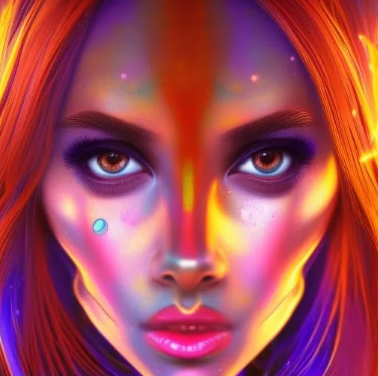
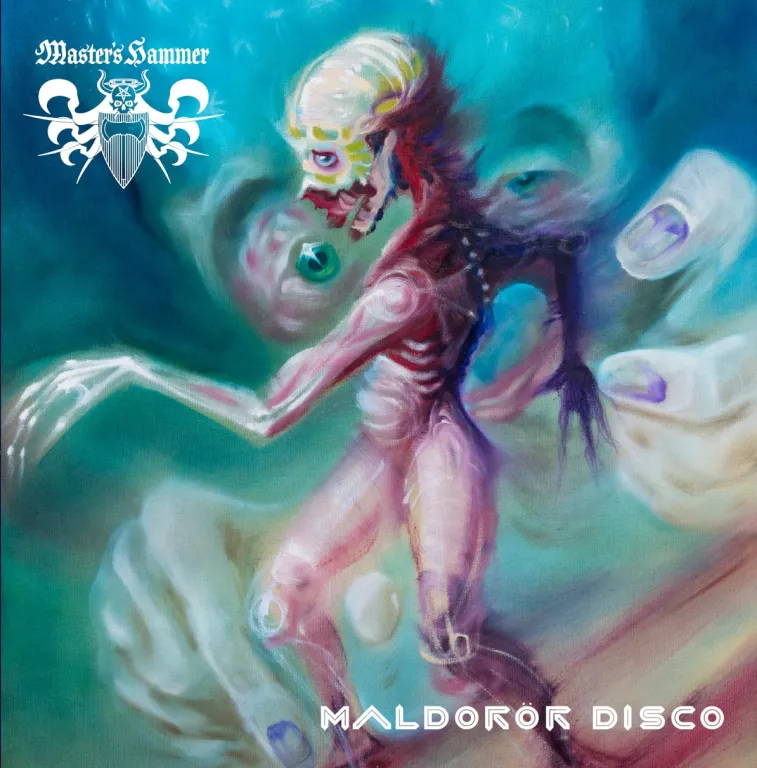
Some paintings and drawings were created even before the respective songs. The truth is, I hold a paintbrush in one hand and a guitar or synth in the other at the same time. The front cover was chosen by the DSR label—it tells the story of body modification: a dancing half-dead Frankenstein disco-zombie—all themes that are present in the album’s lyrics.
Would you say the artwork is part of the music, or is it a separate project that happens to live alongside it?
You can enjoy the audio and visuals as a Gesamtkunstwerk, but they can also live separately. I hold exhibitions where there’s no sound—just silent animation projections. Music is best experienced with friends around you—to dance with. Listening to music alone is a bit like drinking alone—it’s better shared. Visual art, by contrast, can often be understood more deeply when viewed alone in a gallery. Performative art mixes both attitudes—and that’s what happens on stage when our animated drawings are projected onto us and the backdrop.
Could you walk through the process of creating a cover that looks as strange and intentional as it does?
If I could have created something specifically for this album, it would probably look completely different—but the approved design had to be public before mixing was even finished. A designer’s work should ideally be based on a finished album—yet when the artwork was painted, songwriting hadn’t even begun. Personally, I would’ve preferred something from the dozens of phenakistoscopic drawings now inside the booklet—many of them relate directly to the songs. In the end, though, it doesn’t matter. The cover has the right feeling, suits the music, and stands out from other bands, design-wise.
Long-time fans will recognise Master’s Hammer in this album, but might be surprised by how far it goes. Were you thinking about the audience while writing, or just the music?
My first audience is my bandmates—if they like it, maybe others will too. I think long-time fans will recall Šlágry, an album also based on cover versions and lots of experimentation. But I’d actually be interested in composing a song or two that deliberately matches fans’ tastes—honestly, I’m open to suggestions!
You’ve always defied genre expectations. What makes you feel a project is successful if it’s not about pleasing listeners?
I think I see where the issue could lie—a possible misunderstanding of hardliners. I have great friends among radical metalheads—I came from that world myself. I fully understand their stance and never ask for admiration of my divergence. Our aim is simply to show an alternative route out of convention. I admit my bad taste can be a little toxic—but never intentionally rude, or seeking success on that basis. Pleasing the listener is absolutely the top priority—far more important than glory. Genre expectations? I’d rather leave that to the more qualified.
Looking at all nine albums, how do you see Maldorör Disco fitting into the band’s larger story?
Each last album becomes my favourite—but that changes over time. On the record shelf, Maldorör Disco would probably stand somewhere between Šlágry and Formulae.
https://www.facebook.com/MastersHammerOfficial
https://darknessshallrise.de/?s=Master%27s+Hammer&post_type=product&v=5269f4d75f5b
Share: