
Revisiting Infidel Art for its latest reissue, Sigh reflects on the album’s experiments, its missteps, and the moments that still resonate. Their latest album, I Saw the World’s End – Hangman’s Hymn MMXXV, arrived June 13, 2025, but that’s another story – here, we focus on the early experiments that shaped the band.
When you put Infidel Art back under the microscope for this reissue, what jumped out first – something you loved, or something that made you cringe?
“Infidel Art” was the first “symphonic” album by us, and the last album, “I Saw the World’s End”, is its goal. I’ve learned a lot about music for the past 30 years, and the digital technology has evolved a lot, too. I remember going to the musical instrument shop back then and asking the staff which synthesizer could generate the most realistic string sound. They suggested TS-12 by Ensoniq, which I bought and used for “Infidel Art”. Now nobody would think that its string parts sound “realistic” any more, but back then it sounded really grandiose. If I recorded “Infidel Art” with the same member as “I Saw the World’s End”, I could make way more symphonic and powerful album, but I don’t know if that’s what the fans want. I myself have no will to do it, either because the flaws are part of the charm of “Infidel Art”.
Those original DAT tapes must’ve been like opening a time capsule. Did anything unexpected crawl out of the mix?
Actually, it was just remastered, not remixed. The album was recorded on analog reel tape, not DAT. And the reel tapes were so expensive that we couldn’t buy them from the studio after the recording, so the original separate tracks are forever lost.
Back in ’95, Infidel Art felt huge – grand, theatrical, unapologetically strange. What made you confident enough to take that leap so early on?
When I was making “Infidel Art”, I visited Norway and somebody played “Shadowthrone” by Satyricon, which hadn’t been out yet, to me. Honestly, I was not sure if I should use synthesizers to that extent, but “Shadowthrone” obviously pushed my back. I also found out that Svert was using an Ensoniq synth, too.
Zombie Terror and Izuna have that sweeping, almost horror-symphony energy. Were you chasing that cinematic feeling consciously, or did it just happen through instinct?
Those were the influence from an occultic comic book named “Kujaku-O”. I started to consciously take in the horror soundtrack feels in our music from “Hail Horror Hail”, but when I made “Infidel Art”, I don’t think I had the will like that.
Would you say Infidel Art was the last breath of the “old” Sigh or the birth of something entirely different?
Well, you can say so. I started exploring more “experimental” spheres from “Ghastly Funeral Theatre”. Our albums sound quite different from each other, so the definition of “old Sigh” can be varied, though.
Being connected to Deathlike Silence while living in Japan – how strange did that feel? Did you ever sense how significant that bridge was becoming?
When we did “Requiem for Fools” EP, I sent it to all the labels from all over the world I knew to see if any of them would be interested in us. And Euronymous was the only one who wanted to sign us. Back then, everybody was enthusiastic about death metal/grindcore, and 80s thrash metal was considered to be completely outdated. “Requiem for Fools” was heavily influenced by thrash metal, so obviously nobody except Euronymous was interested. Abigail and Sigh were pretty much fed up with death/grind and missed the bands like Venom, Celtic Frost, Bathory, etc., and I was really surprised to see that there were some groups in Norway, who felt exactly the same way.
The Scorn Defeat lineup stayed intact for this record. Did that familiarity make things easier or did it create its own kind of pressure?
Well, I didn’t think about it that much. As I said, everyone was into death/grind, so I had no hope to find a new member, who might be interested in what we were doing. So working with the same guys was the only choice anyway.
Japan’s scene in the early ’90s was small but fierce. How did the energy there compare to what was happening in Norway or elsewhere?
It was very small. At first, only Abigail and we were in the scene. Sabbat was already there, but they were located far from Tokyo. Before the Internet, the Japanese scene was always 2 years behind compared to those in Europe or in the US. When black metal started becoming big in Norway, nobody here was aware of it.
People talk about Infidel Art like it’s an “outsider classic.” Did you ever feel like outsiders yourselves, or was that just the natural state of being Sigh?
Being a Japanese band in the metal scene already means that we are outsiders. I guess we are outsiders within outsiders.
You were working with classical and symphonic ideas before it became fashionable in metal. What pushed you in that direction?
My 2 biggest musical backgrounds are metal and classical music. As my mother was a classical piano teacher, I started taking lessons at the age of 4. So it was quite natural for me to take in the symphonic elements.
If you could explain the word infidel the way you felt it back then – not in translation, but in emotion – what would it mean?
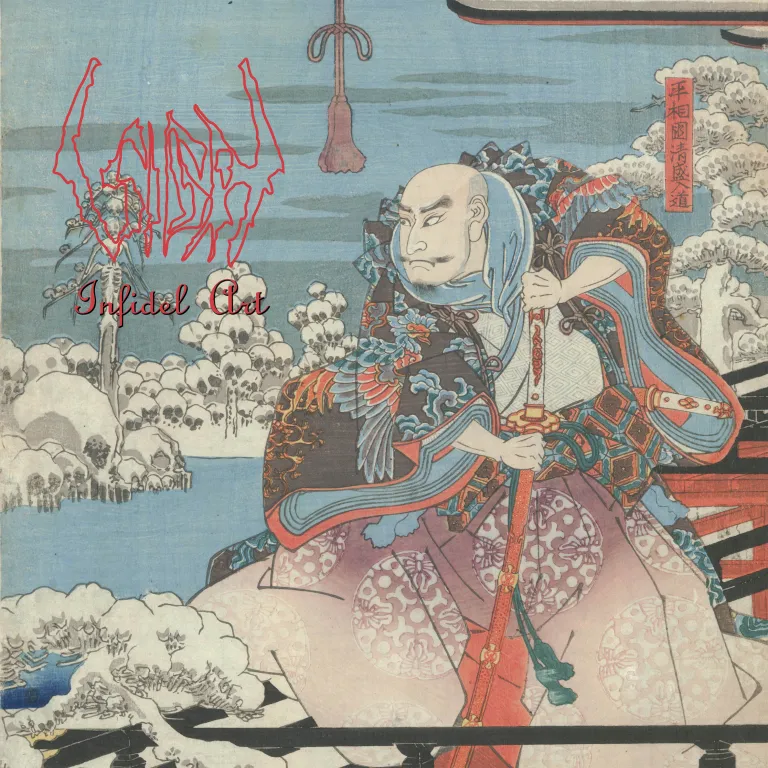
To me, the word “Infidel” was the perfect one to describe the cover artwork. It is a very old Japanese painting. At the very first glance, it looks really beautiful with the snowy scene, but if you look into the details, there are a lot of eerie things such as skulls in there. It is infidel art for sure! And all of what I said here can be applied to the music of the album.
There’s something intellectual about Infidel Art, but also very emotional. Were you trying to prove something to yourselves musically?
I started learning music theories around that time, so I really wanted to use it for the songs. In that sense, Infidel Art was more intellectual than emotional compared to “Scorn Defeat”. But my knowledge back then was really limited, so still everything is rather primitive.
Sigh’s darkness has always felt spiritual more than religious – and very Japanese in tone. Do you think that nuance ever got lost on Western listeners?
Definitely, we are not religious in any way. Actually, we never tried to sound Japanese before, but I guess they still sound Japanese here and there, and I think the Western listeners can sense it. On the other hand, “Shiki” was the first album, which I made it sound Japanese consciously. And as it is a very Japanese album, both lyrically and musically, I guess it won’t be easy for non-Japanese to fully understand it. But anyway, when you listen to music, you don’t have to “understand” it.
Outside the band, what keeps you centered these days – what still sparks that creative nerve?
Well, even outside the band, music is my main thing. I listen to a lot of music and play a lot of instruments for fun. Also, I work for a record label. I do some workouts and play mahjong, etc., but mainly I do things connected to music.
When you revisit old work like this, does it ever pull you into nostalgia, or are you more curious about what still feels alive in it?
It depends. “Infidel Art” had been my least favorite album by Sigh. “Scorn Defeat” is a very primitive album, but that’s its appealing point. I tried to make “Infidel Art” more sophisticated, but it ended up primitive. That’s why I hated it for a long time. But at one point, I started thinking it wasn’t as bad as I had thought.
You’ve always balanced absurdity and seriousness in Sigh – horror next to humor, philosophy next to chaos. Does that duality come from how you see everyday life?
That is exactly who I am. I love anything extreme, whether it be horror or humor. I don’t want to pretend to be someone I am not. I am not a 100% grim person. Sigh’s music is a reflection of myself.
Between Shiki and the reimagined Hangman’s Hymn, it feels like Sigh is both reflecting and rebuilding. Do you think of this era as a renewal or a reckoning?
Well, “I Saw the World’s End” has almost nothing to do with today’s Sigh. It was just my unfinished business and I had to revisit it, but the next album will be the direct sequel to “Shiki”. Of course, re-working “Hangman’s Hymn” slightly influenced it, though.
Younger avant-garde bands cite Infidel Art constantly. How do you process being that kind of reference point now?
Oh, really? I am not aware of that. If they cite “Hail Horror Hail” or “Imaginary Sonicscape”, I can understand it, but “Infidel Art”… I don’t know. I sometimes see someone say “Infidel Art” is his / her favorite album by us. I wouldn’t say it’s a bad album, but to be honest, I don’t know what part of “Infidel Art” makes it a better album than other albums of ours.
When someone hears this new master for the first time – no nostalgia, no baggage – what do you want them to feel in their gut?
I don’t know! It is a very old school album, and the production is very different from today’s albums. So I have no idea how it sounds without nostalgia. Honestly, I want people to listen to “Shiki” or “I Saw the World’s End” first and then go back to the back catalogues.
Share: