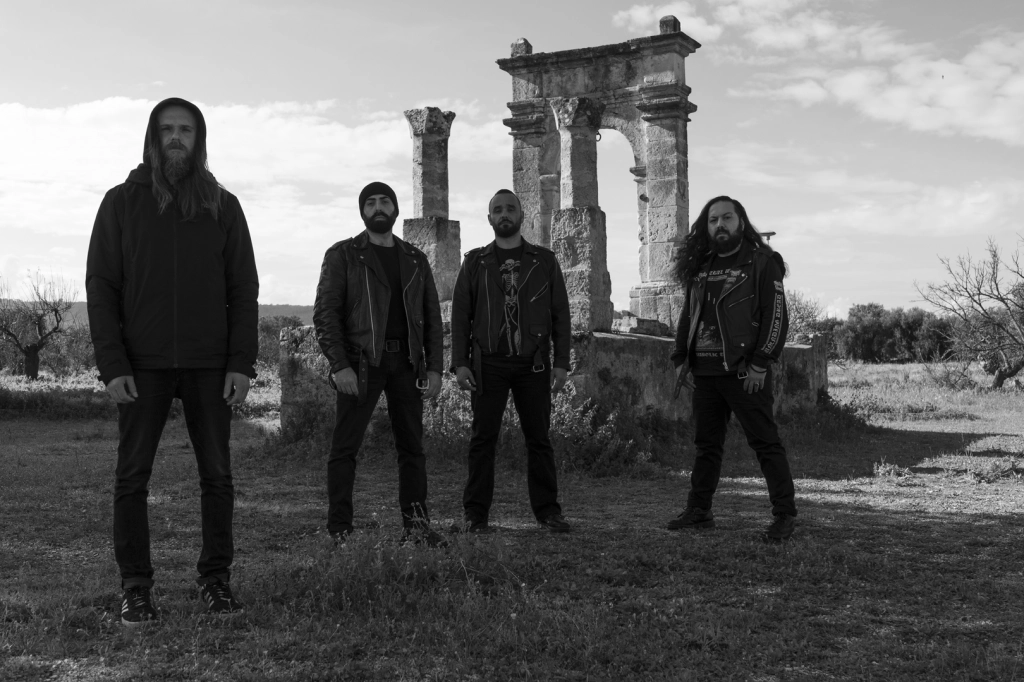

Italy’s laCasta continue to push their sound deeper into hostile and ritualistic territory with OLIBANVM, a record where black metal atmosphere, crust urgency, and symbolic violence merge into something both oppressive and strangely hypnotic. Built around themes of transformation through suffering, the album treats ritual not as comfort, but as pressure, rupture, and collapse. I spoke with guitarist and composer Mario Morgante about the album’s conceptual foundations, the balance between aggression and restraint, and why laCasta increasingly see themselves operating in the space between black metal and crust rather than fully belonging to either.
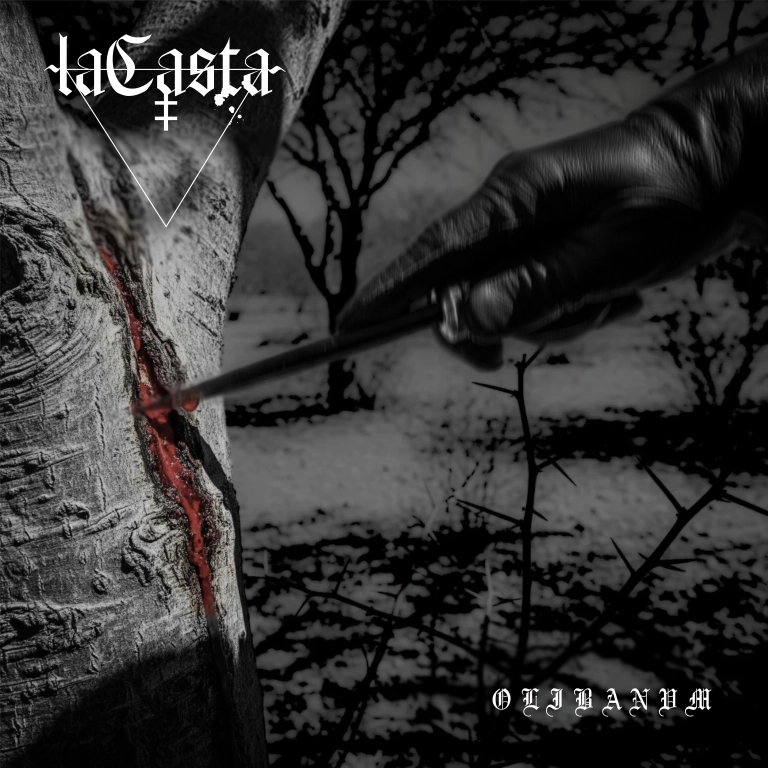
The concept of ‘Olibanvm’ revolves around incense extracted through deliberate wounds. At what point did that image become the emotional core of the album rather than just a lyrical motif?
It became the core when we realised it wasn’t simply describing the concept, but reflecting the way the music itself was forming. The idea of something precious emerging through violence began to mirror the compositional process: tension, rupture and the extraction of something essential from that fracture. At that point, it stopped being an illustration and became a structure.
There’s a ritualistic quality running through the album, but it never feels mystical in a comforting sense. What attracts you to ritual as something violent or transformative rather than spiritual refuge?
Because ritual, in its origin, is never comfortable. It is a transition and transition is never neutral. It implies loss, force and change. We are drawn to ritual as a mechanism that transforms through pressure rather than offering protection from it.
Black metal and crust both carry rawness, but very different emotional energies. What do those two genres allow each other to express inside laCasta that they couldn’t alone?
Black metal allows space, atmosphere and a sense of collapse that is not immediate. Crust brings urgency and direct physical impact. Together, they create a tension in which neither stasis nor pure aggression dominates. One expands time, the other compresses it.
The symbolism of blood, gold, and incense runs throughout the album. Did you approach those images more historically, spiritually, or psychologically?
We never treated them as separate categories. Historically, they carry power, ritual and extraction. Spiritually, they relate to transcendence and control over death. Psychologically, they represent value produced through violence. All these layers coexist without hierarchy.
There’s a relentless forward momentum to the material, but the album also knows when to slow into something almost oppressive. How important is restraint in music this aggressive?
Restraint is what gives aggression weight. Without it, intensity becomes flat. The slower or more suffocating sections are not decorative contrasts, but structural pressure points that make the faster moments necessary.
Was there a moment during writing where the album became darker than you originally intended?
Not darker in a deliberate sense, but more uncompromising than expected. At a certain point, the material stops following intention and begins to reveal its own direction. We did not try to correct it.
Compared to ‘In Æternvm’, what part of laCasta’s identity became sharper or more exposed on this record?
Physicality. This album is less atmospheric as distance and more direct in impact. The identity is less veiled and more exposed in its structural violence.
How do you prevent extremity from becoming numbness when writing music built on intensity and abrasion?
By avoiding uniform intensity. If everything is extreme, nothing is. We aim to work through contrast, erosion and dynamics rather than constant escalation. The goal is impact, not saturation.
There’s a strong sense of inevitability across the album, almost as if the songs are collapsing under their own weight. Was that atmosphere intentional from the start?
Yes, but not as a narrative concept. More as a structural instinct. The music was built to feel like it is moving toward collapse rather than resolution.
The phrase “No compromise. No redemption.” feels less like a slogan and more like a worldview. Does that mentality shape the band creatively beyond the music itself?
It functions more as a filter than a statement. It shapes decisions in terms of coherence and direction, not ideology. It defines what is excluded as much as what is included.
At this point, do you see laCasta more as an evolution of black metal, an evolution of hardcore, or something that no longer fully belongs to either world?
Neither exclusively. Both genres are part of the language, but the intention is not to evolve them. It is to operate within the intersection they create, without needing to resolve into a single identity. In this latest work, however, black metal is more dominant than hardcore: we like to define ourselves these days as crust black metal, a definition that feels more accurate to what we have become.
Thank you for the space and for the questions; it has been a pleasure to go into detail on ‘OLIBANVM’. A greeting to everyone reading and to those who continue to follow our path.
Share: