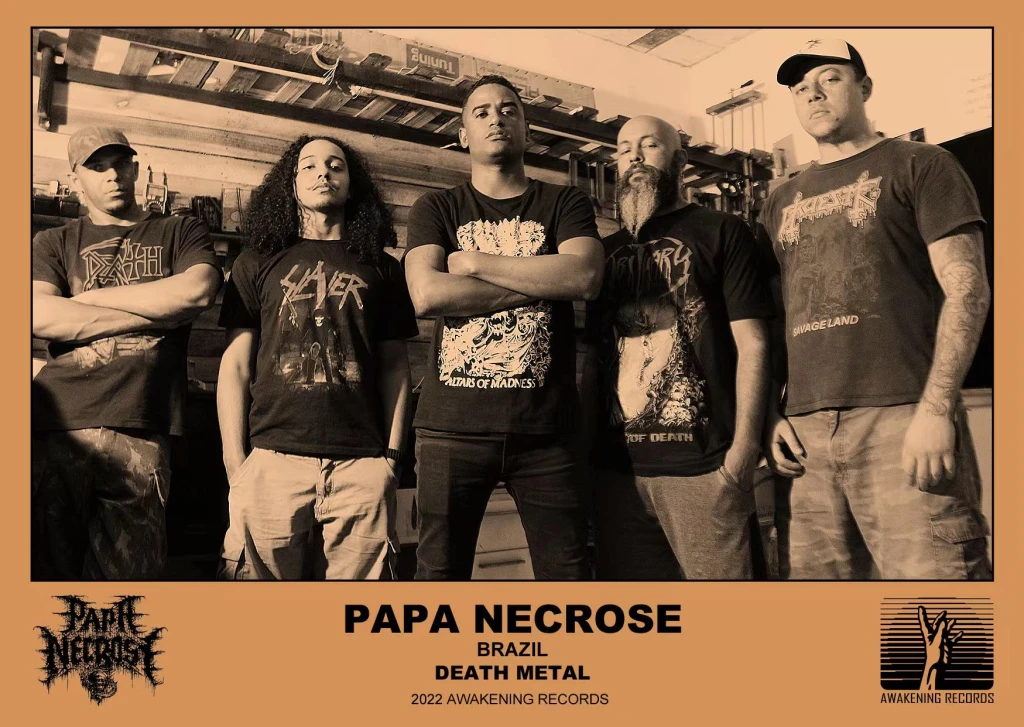

Hailing from Salvador, Bahia, a city with a deep but often overlooked extreme metal history, Papa Necrose have been grinding their way through the underground since 2010. With Anthropomorphy Execution, the band sharpens both its sound and its message, delivering a record rooted in classic death metal while pushing a fierce ideological edge. We spoke with Danilo about the band’s evolution, the realities of the Brazilian scene, and the uncompromising themes driving the new album.

Hi! Papa Necrose comes from Salvador, Bahia – not exactly a city people usually connect with death metal. What was the scene like there when the band started?
Danilo – Hello to the entire Antichrist magazine team, we are grateful for the invitation, a big hail to all the readers, and a big hug, Stanley.
Salvador/BA is a city that is quite culturally alternative, the artistic movement is very strong and in the old days, Punk, Metal, Rock, and even Axé, lived a real war in the streets, where daily conflicts happened due to presence and ideology ahahaha.
We have old bands that, since the 80s, have paved this tortuous path of playing in a land where Rock is sidelined by all possible media, but bands like Krânio Metálico, Mercy Killing, Chemical Death, and later with Headhunter, Mystifier, Crucificator, bands that gave an extreme face to our city. Today, we continue this along with several other important bands for the national Underground.
The band goes back to 2010. That’s a long road already. Were there moments when you almost called it quits?
Danilo – There’s never been a moment like this before. Of course, the journey of an original band starting from scratch is a real struggle, but that makes us fully dedicated and committed. We have an important purpose, which is to associate professionalism with the Underground, breaking the distorted view that many try to sell about the Underground, which should never have been associated with a lack of quality, but rather with devotion to subversive culture.
Now that Anthropomorphy Execution is about to see the light, how do you see the difference between this band and the one that recorded the debut?
Danilo – A lot has changed in recent times, but the essence of the band remains the same. We refine our technique a bit, we improve our equipment, we add more ideas to the album’s production, but our motivation and roots remain. We continue to argue about the fascist stances that Catholicism imposes on humanity and draw this parallel with the ideological/political critique that the band has always brought.
The record took quite a while to finish – parts of it were worked on from 2023 up to 2025. Did the songs change much during that time?
Danilo – Man, it actually took longer than I expected, but it was something that only brought benefits. It’s a fact that pre-production took quite a while, but the album couldn’t have achieved a better result.
Sometimes when I watch the videos we recorded at the beginning of the album’s compositions, I notice the numerous modifications, but they were changes that made the songs more complete; a lot of atmosphere was added as well.
The production isn’t overly clean. Was that a conscious choice when you were recording at Evil Live Studios?
Danilo – Absolutely. When Luquian started the mixing work, we talked about how we could prepare the album without losing our roots, but we knew that the songs were on another technical level.
We tried to make the whole process sound organic, even with the most digital tools of today. We left some noise at the end of the mastering at the band’s request and tried to add polish with another professional (Hugo Elias) for the drums, managing to maintain a distinctive characteristic in the final result.
Some riffs definitely hint at early ’90s technical death metal. Were albums like Human or Testimony of the Ancients spinning while you were writing?
Danilo – These are albums we would never stop listening to; they’re part of our everyday headbanger routine, whether we’re doing laundry, cooking, studying, reading books, or having drinks with friends. Not only these, but also Cause of Death (Obituary), Considered Dead (Gorguts), Cursed (Morgoth), The Ten Commandments (Malevolent Creation), among others that I could spend the whole interview listing. These are the albums that influenced us, including our decision to play instruments.
Let’s talk about the title. Anthropomorphy Execution is a pretty striking phrase. Where did it come from?
Danilo – Anthropomorphism is a thesis that discusses religious belief directly associated with animal characteristics, and we apply this to criticisms directed at the Catholic Church (as always). We believe that at the Western root of belief, the etymologies and myths related to the religious aspect were destroyed and hidden by Europe with the attribution of the Christ of the Middle East as if he were a main Western figure. Much was modified by Roman power and subsequently, all other religious cultures were practically destroyed in various ways so that the Christian thesis could be inserted throughout the world, adding a much freer capacity for power manipulation. Thus, the gods attributed by indigenous and aboriginal peoples were eliminated.
A lot of the lyrics go straight after organized religion, especially Catholicism and its historical role in wars and power. Why focus on that angle for this album?
Danilo – In fact, our focus has always been the Catholic Church. For us, the Vatican is responsible for all the chaotic moments of modern humanity; it is no coincidence that it is the entity with the most power in the world. I still think that all humanitarian crises on our planet are influenced by the Vatican, precisely because it is in crises that people’s religiosity is put to the test, and that is when people become more fragile and easily surrender to the spiritual aspect of the difficulty. We prefer not to waste time talking about magical beings like the devil or Jesus, since it is in the material organization that human misfortunes are practiced day after day.
The Catholic Church financed Nazism; we have had numerous pedophile, anti-human popes, but they are overshadowed in human history by various other humanitarian crises. The Catholic Church is the very antichrist that they themselves claim to fight against.
Being openly critical of religion can still stir reactions depending on where you are. Is that something you think about at all?
Danilo – But that’s our intention, hahahaha!
We’re here to encourage people to think. I consider that favorable, haha.
Song titles like “Bleeding Social Membrane” or “Hammered in the Mind” have almost medical imagery.
When you write lyrics, do they start with ideas or with strange images first?
Danilo – The idea behind this song is to critique, in a biological and pathological way, the society we live in, the bleeding of the thin layer of society that is the membrane, how fragile our relationships are, constantly based on profit and taking advantage of one another. A critique of the exploitation of man by man. The social fabric is rotten; over time we are losing the notion of life, and what remains is death and its consequences.
“Cathedral of Death” could mean many things. Religion, war, mass graves. What’s the story behind that one?
Danilo – The idea behind this song is to speak, in a harsh, creeping, and rhythmic way, about the various religious temples around Brazil and the world that were erected on the blood of slave labor. Cathedrals of Death, “Sacred” places that, to be built, were based on death and slavery.
The title track itself – “Anthropomorphy Execution”. Is the idea about humans creating gods and systems of power in their own image?
Danilo – That’s it, and it’s the responsibility of the Catholic Church in the cultural execution of the Latin and Eastern worlds. As always, Europe usurping the land and heritage of the smaller lands.
Europe shaped the image of the Palestinian “Jesus” with European features not only to facilitate religious acceptance but also to shape the image of a pseudo-hero of humanity.
The closing track, “The Thousand Yard Gaze”, includes a guest solo from James Murphy. How did that happen?
Danilo – Man, it was crazy. Our vocalist had a friend’s contact on Instagram who they talked about Death Metal with, but he never imagined she was James’s partner. In one of their conversations, he introduced her to Papa Necrose, she said she would show it to her husband, and out of nowhere, the guy was James Murphy, the genius of solos on the best Death Metal albums ever.
One day James posted a video listening to our album in the car, the next day Alessandro talked to him and proposed a collaboration, and to his surprise, the answer was favorable.
This only proved to us how Metal is without barriers and how awesome James is, in addition to his paranormal ability to solo that absurd track. He didn’t charge for it and took the time to listen to the song several times to deliver a simply magnificent and exquisite solo. To this day, we can’t express how grateful we are for the attention of our greatest idol in the world of Death Metal.

The phrase “thousand yard gaze” usually refers to soldiers after war. Was ending the album on that note a deliberate move?
Danilo – Our vocalist is fascinated by World War II and wanted to address this topic, which we had never discussed before. The traumatic experience soldiers go through after the war, and how they have to cope with this period filled with physical and mental trauma, where an abyss of uncertainty opens up before them and the doubt about having a normal life corrodes what little humanity they have left.
Death metal today is all over the place – ultra-technical bands, cavernous production, super polished records, old-school revival stuff. Where do you think Papa Necrose fits?
Danilo – I believe the band occupies a place within the family of those that make a sound that is essentially traditional but incorporates technique, because the band became that way due to the hours of study by its members. I think Malevolent Creation is “Old School” because it’s from that era, but the sound is extremely technical and even progressive. Pestilence had its “Old School” phase and then an extremely technical one, as did Skeletal Remains, and Death is another story altogether. Obviously, the term “Old School” came to be used as a style of sound because it attributes old characteristics to the meter, equalization, and logic of the composition, and not just because it’s old.
People keep saying death metal is either dying or “coming back”. From your perspective in the underground, what’s the scene actually like right now?
Danilo – The person who says that Death Metal is dying is because they themselves are already dead. It’s one of the styles within Metal that is most constantly updating and adding new proposals to the style; it’s so inclusive and open to new possibilities that there are a lot of trash bands that play gospel or NS music within the style’s framework.
It’s an extremely democratic sound that receives new bands and proposals every day. It’s up to the Headbanger to feel represented or not. If the person making this type of criticism doesn’t identify with the style, I understand, but even representing Death, Death Metal is more alive than ever.
Looking ten years ahead – what would you want Papa Necrose to be remembered for?
Danilo – As a band that, above all else, is family, that respects and strives to deliver the best work for its audience, that still evokes real emotions in its listeners, and that will continue to curse the fascist and vile entity called the Catholic Church.
Someone listens to Anthropomorphy Execution from start to finish. What should stay with them when the record ends? Thank you for your time!
Danilo – We want them to understand our lyrical proposal along with our political/ideological stance. Musically, we want it to be marked by our sonic identity, allowing them to perceive all our references but also absorb our originality in the way we assemble our ideas. We want them to know the power of Latin and brazilian extreme music, which isn’t limited to the country’s popular music and isn’t confined to just Sarcófago and Sepultura. We have countless brilliant bands in our country, and we are simply continuing an important legacy of bands like Vulcano, Headhunter DC, Mystifier, Dorsal Atlântica, Ratos de Porão…
We appreciate your attention and support.
https://www.facebook.com/papanecrosedm
https://www.instagram.com/papanecrose/
Share: