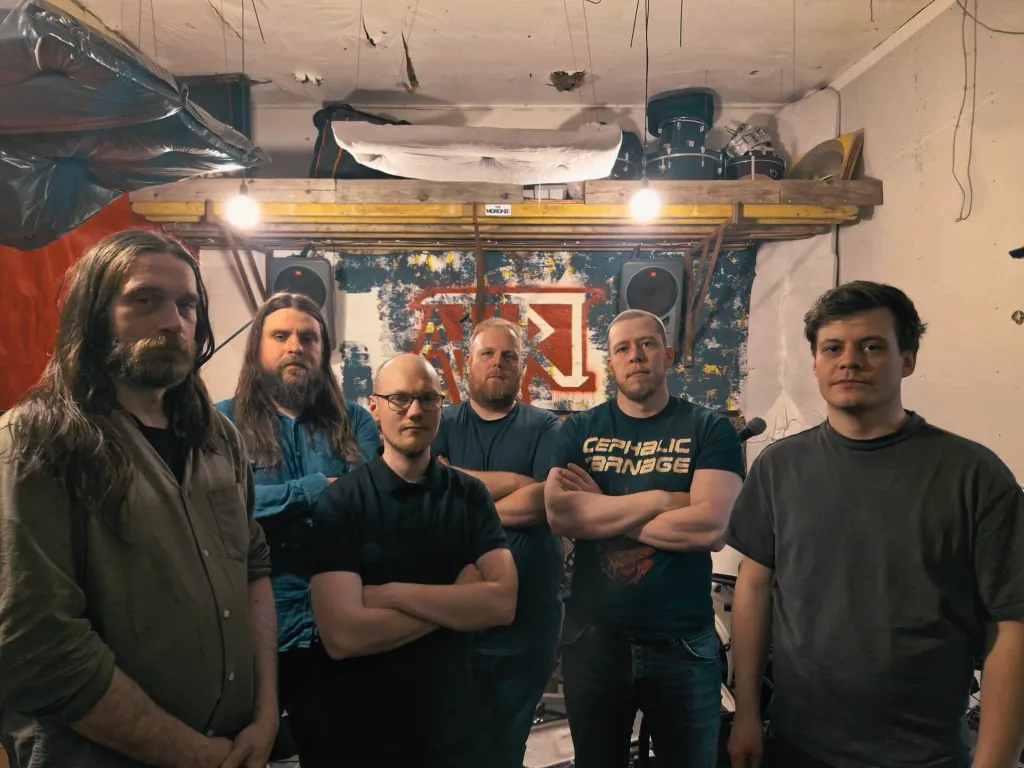

Sleeping Giant has just released The Beauty of Obliteration, a six-track live recording. I spoke with Árni Björn Björnsson (guitars) about the approach behind the record, their songwriting process, and the themes shaping their sound.

You’ve just unleashed The Beauty of Obliteration – six tracks culled and refined from your catalog into a single statement of intent, recorded live as a unit in Stúdíó Paradís. Did the idea of capturing the band as a live force in the room change anything about how you approached these songs?
ÁB: No, we aim to have as little of the parlor tricks between the studio, the rehearsal room and live, meaning we can absolutely replicate what you hear on the album once you hear us live.
The opening track Conqueror hits hard and even gave the album its title. Did that track set the tone for how the rest of the record came together? When you were arranging this track, was there a moment where the song felt bigger than just the music, like a theme emerging that demanded the rest of the record be shaped around it?
ÁB: Perhaps inadvertently – it’s usually been the song we open with, which surely influenced the decision to have it coming first. The heavy, unsettling atmosphere that Conqueror begins with definitely does set the tone for the dystopian, misanthropic soundscape of Sleeping Giant, but yeah, the decision wasn’t a strategic masterplan.
Mobilizer of Evil already has a video out and it’s a relentless burst of groove-driven heaviness. In the room, when that riff first locked in with drums, did you feel it had something almost unstoppable about it? How did that energy push the rest of the tracking?
ÁB: Yeah, definitely, and not just in the room – from day one, Mobilizer has pretty much taken that relentless momentum with it. The lyrical matter of Mobilizer also helps push the grittiness of it all the way and hasn’t stopped being relevant since it was first crafted about 15 years ago.
A lot of the lyrics, from The Monk to Abysmal Flame, mix mythic imagery with raw, almost grotesque scenes. Were the words written alongside the riffs, or did the music actually hint at its own storytelling as you were recording?
ÁB: I think it usually doesn’t start off in a tangent, the initial process is all over the place but usually goes a little like this; “have zillion riffs, arrange the riffs, arrange the lyrics” and we all have our input on the process until we’re all content with the direction of it. There’s also way more fun to write about something grotesque!
Speaking of The Monk, its gritty, relentless sludgy grooves contrast sharply with some of the album’s slower doom parts. Did you ever find yourselves letting a really heavy groove take over a song, almost beyond your control?
ÁB: Inevitably it does happen up to a point, sometimes the convergence of the guitar and drums takes on a life of its own when working on it. We however try to be as cohesive as possible without being too repetitive.
Slay the King of Hell rides this huge stoner-doom riff that almost feels like a journey. From a playing standpoint, was there any mechanics or arranging decision that made you keep that one so long and rolling?
ÁB: Like most songs on the album, this initially is a pretty old work and we first worked on it with our first drummer, Magnús, when Sleeping Giant existed as a four-piece. Slay was initially more of a half-time stoner/doom track before Ási took to harshening the groove to the best of his abilities and help make it the relentless riff-fest that it is today.
On the other end of the spectrum, the shorter Venom Ripper, Gorgon Blaster is a blast of old-school thrashing intensity. What do you think made that one stick as such a focused, short-and-punchy track on a record that otherwise favors sprawling heaviness?
ÁB: It would probably do it a bit of a disservice to call it a joke track, but when it was written, it was intent to make a fun, sort-of 80s thrash/NWOBHM-style track with lyrics very heavily on the bad-guy-hail-satan-kill-’em-all spectrum – we have a lot of fun playing it and it‘s jam packed with metal clichés.
The closer, Abysmal Flame, is the longest track here and has become kind of a signature piece live and in the recording. Was that extended form something you intended from the start, or did it grow naturally as you recorded?
ÁB: It’s the oldest song we still play so it’s hard to recall the exact thought process that went into it but I do think we set up to make it a bit of an epic. The song and lyrics play well together here, with the lyrics being rooted in the Poetic Edda part about Ragnarök. The progression of all the riffs blends together really nicely with the lyrics, and they end in a really doom-y manner once the old norse prophecy of everything ending comes to fruition.
Reviews and listeners have noted that while your sound has clear stoner and doom roots, there’s also a sludgy, almost death-edge to the vocals and aggression. Did you ever feel pulled between leaning heavier into doom versus pushing throw-heavy extremity?
ÁB: I can’t really speak on the vocal techniques being utilized for the tracks but musically, we’re all over the place and since we’re influenced by various bands and styles it tends to come across that way. Personally, I think the straight-forward guttural and growly vocals add a good cohesion to the variety of underlying riffs.

The album encompasses such massive grooves and thick, memorable riffs that some reviewers compare you to classic heavyweights but also newer giants of heavy psych. Did making this debut feel like defining your own lane before anything else?
ÁB: Not as a clear mission statement but perhaps unintentionally. When we’re working on music we definitely hear what riffs and grooves make the cut pretty quickly. Comparisons can be helpful but sometimes feel like you‘re being boxed in a bit, we‘ve always tried to make Sleeping Giant tracks first and foremost.
Iceland’s scene has a reputation for extreme music – from black metal to massive doom and sludge. How does your home turf creep into the tonality, pacing, and atmosphere of what you do here?
ÁB: I think it‘s bound to happen, there‘s a lot of sombre melancholy in a lot of artists even though they‘re not on the extreme-metal end of the spectrum. Collectively, we as a nation are bound to be somewhat affected by harsh winters with no sunlight as well as the proximity with nature and its forces, and it in turn shapes how we see the world.
With The Beauty of Obliteration, you’ve dovetailed riffs that are sinister and unforgettable with grooves that feel like they could melt faces or floors. Was there ever a moment in the studio where you unexpectedly found a tone or texture that redefined a track?
ÁB: When we entered the studio we had the tracks pretty much nailed, in the sense of what we wanted to do. Perhaps we rushed a bit in that sense, although we‘re all happy with the outcome. But the magic you‘re asking about here is usually something that happens when rehearsing.
This record blends heavy genres, doom, stoner, sludge, death, even a bit of thrash, yet it comes off cohesive rather than confused. Were there any particular arrangement battles where you had to decide whether to keep a part big and sprawling, or trim it to the point?
ÁB: Yeah definitely, it’s rare that I or someone else comes in with a song idea that doesn’t go through some cutting and polishing before coming together. Normally we can tell quickly if something feels off, and it’s a joint effort to arrange it.
The title The Beauty of Obliteration comes from a lyric deep within Conqueror. On a creative level, did that line act as a guiding principle for the record, or was it more of a retrospective choice once the heaviness locked in?
ÁB: We didn’t have any concrete title in mind when we finished recording, so it was a happy accident, really, that occurred to us after the fact. But, speaking for myself, I absolutely think it defines what we’re all about and the recurring theme of the songs.
https://www.facebook.com/SleepingDoomPungur/
Share: