
At the very beginning of last year, the Polish one-man project Faustus released its debut album Act 1 through the local label Putrid Cult, known primarily for its black metal catalogue. Although Faustus itself is a brand-new project with little history behind it, the musician responsible for it, Cezar, is already well known in extreme metal circles as the frontman of the highly respected melodic black metal band Christ Agony. One might naturally expect Act 1 to follow a similar path. Yet side projects exist precisely to provide room for experimentation, and with Faustus, Cezar explores a territory where dark, gothic, death, and black metal intersect.
Founded in 2024 in the northern Polish town of Morąg by Cezary “Cezar” Augustynowicz, Faustus became yet another addition to his remarkably prolific professional biography. His musical interests are strikingly diverse – for example, in HimAir he plays melancholic gothic rock, while in Topielica he turns towards progressive rock. Because of that, it was fascinating to approach Faustus without immediately viewing it through the lens of Christ Agony, even if certain parallels inevitably emerge. Before releasing the debut full-length, Cezary introduced the project through the singles “Piąta pieczęć” and “Adoracja magów” both of which later appeared on the album itself. And the first question that came to my mind was this: if this album had been released under the name Christ Agony, would it have come as a surprise? The answer is unquestionably yes. Faustus is about atmosphere, expression, theatricality, and melancholy, yet at its core remains extreme metal rather than softened rock adorned with various dark-sounding labels.
The first thing that immediately stands out is the use of Polish lyrics. They do not simply alter the mood of Act 1, they almost function as an additional instrument. Written by mysterious personality Ferosap, the lyrics add an irresistible flavour – a mixture of folklore, the Middle Ages, ancient forests, and the damp smell of forgotten cellars where occultists once gathered in secret. It is equally impossible not to comment on the emotional intensity that flows not only from the Polish language itself but also from Cezar’s vocal delivery. His performance is extraordinarily vivid and passionate, though not in a poetic or lofty sense. Instead, it feels closer to lamentations and fairy-tale rhymes. Melancholy on this album does not wear aristocratic gowns but the patched robes of wandering sorcerers, while remaining just as fragile and detached. The music itself possesses an almost ritualistic quality – not because of trance-like rhythms or whispered incantations, but because somewhere in the background one constantly senses the flickering presence of a witches’ sabbath or the summoning of millennia-old demons. Since every composition is quite lengthy (some extending well beyond ten minutes) immersing oneself in that state becomes entirely natural. Yet this is not an album easily relegated to background listening; it is far too alive and constantly shifting.
The album opens with the highly atmospheric and subtly folk-tinged “Klątwa wyzwolenia”. At first, Cezar sings in an almost troll-like, mournful manner, but the arrival of clean vocals transforms the mood completely. In general, the interplay between clean singing and screams is exceptionally well conceived, lending the music a theatrical extravagance that breathes life into the otherwise deliberately repetitive song structures. This is especially evident on “Przywołanie wiedźm”. Some tracks drift towards dark gothic territory, though black metal remains the dominant force throughout. “Epifania mocy” is the album’s most optimistic and martial composition, whereas “Adoracja magów” leans more heavily towards blackened death metal, subtly recalling Christ Agony. The simplest and most hypnotically repetitive track, “Piąta pieczęć” is crowned by a mystical ambient ending that deepens the clandestine aura of the entire musical work. The album concludes with the most melancholic and romantic piece, “Alchemiczne ognie” – a relatively calm composition punctuated by sudden explosions of energy, driven largely by Cezary’s intensely expressive vocals. Overall, this is not the polished nostalgia of fairy tales or the artificial gloss of Disney fantasies. It is the exposed ugliness of darkness and the fear of death, the real foundations upon which ancient myths and legends were built.
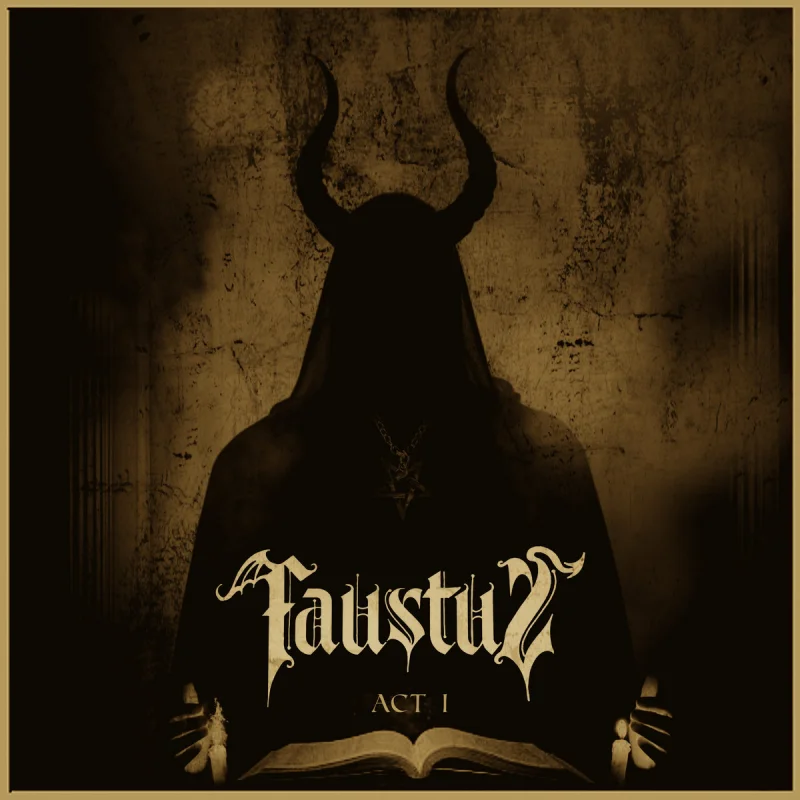
In truth, the parallels with character Faust himself exist mostly on the level of atmosphere and energy. Seeing the band’s name alongside the title Act 1, one instinctively expects a concept album devoted to Goethe’s tragedy, perhaps centered on Faust’s pact with Mephistopheles in the opening act. Even the figure depicted on the artwork seems to encourage such associations. Yet the album is ultimately about something slightly different. Although the Polish lyrics make it impossible for non-speakers to fully appreciate every philosophical nuance or uncover every hidden magical key concealed within them, that never prevents the listener from sensing what lies within Faust’s soul. Act 1 is not about comfort or obvious revelations. It is about the ability to inhabit that atmosphere of darkness and mystery, betrayal and cruelty, the thirst for knowledge, and the eternal struggle against death. And what could serve as a finer soundtrack for wandering philosophical reflections beneath a moonless night than Faustus‘ debut album?
Share: