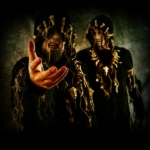

At the very end of last autumn, a Ukrainian gothic/doom band from Kyiv released their first self-titled album Krypta without the help of any labels. And although little is known about this group, the album turned out to be mature and promising within a non-commercial genre, also highlighting ethnic distinctiveness by choosing lyrics in their native language. It is hard to say what musical background these musicians have, but everything is played with professional skill in both technique and song-writing.
In the 21st century, overflowing with thousands of multi-genre bands around the world, it’s not easy to find your own uniqueness and break through beyond a narrow circle of listeners. Back in the 90s, when the gothic/doom genre first exploded, spawning legendary names and hundreds of copycats, much had already been said, and it became difficult to invent something truly new while remaining stylistically pure. But still, new names manage to emerge – full of enthusiasm, bright ideas, elements of novelty, professionalism, and, of course, soulfulness. This is how the music continues to develop, and Krypta has also contributed their share, adorning the world of heavy music with their dark melodies and beautiful female vocals. And this is not just an album, here every track breathes life, a bright flash before fading away. As the musicians themselves say, each song is a mark of the creator’s mortality. In it, they leave a piece of their soul – the spark that drove them to create it. You can really hear it – every piece has been wrung out, filtered through countless emotions and years of growth. It’s always obvious when musicians put so much of themselves into their work, not just enjoying their music or creating it for some specific goal (not even necessarily commercial), but dissolving into it completely. Even if you’re not a fan of this type of music, such an approach always commands respect.
It’s worth noting that this album also contains unconventional elements that set the band apart from many of their peers. The most significant of these is the ethnic character brought out by the vocal parts of their singer. The melodiousness of her voice awakens folk motifs, revealing a Slavic spirit, while the emotionality and strength of her timbre point to academic training, hinting at echoes of classical music. Of course, they are not the first to use such techniques, but they still managed to convey their folk uniqueness and soulful flavour, unafraid to bare their souls, reliving again and again the heaven and hell poured into this music, each time replaying the finished tracks. The “beauty and the beast” method nominally works here, but in fact the contrast between the extreme male vocals and the angelic female voice somehow merges into a single canvas. It’s a performance without theatricality or unnecessary pathos, yet such compositional structure creates a certain aesthetic background. There is something scorching cold in this music, while all its lulling softness is just an illusion – the very moment of release and exaltation when it seems eucatastrophe has finally and unexpectedly come, but in reality, death has crept up on tiptoe.
The foundation of the album is more doom-oriented – slow, heavy, mournful, and dragging, though at times the rhythm leaps forward, but it never reaches speed/thrash domain, more often hovering around mid-tempo. The album begins with the monotonous “Omerta”, whose melodiousness sets the pace for the entire album, while violin parts add romantic notes and a fairy-tale atmosphere. The final track “Shum” also indulges in violin lines, though it is a more modern piece. Like “Meridian” and “Shal”, it hints at alt. rock/modern elements, but still remains far from the commercial direction so popular in the early 2000s. “Imya”, with its sorrowful piano passage, reveals tenderness and vulnerability – a classic gothic/doom track in all its glory. “Petrykor” echoes these vibrations of velvety fragility with its painful and sorrowful melodies. “Uroboros” impresses with its melancholy, while also lightening the heaviness. Throughout the entire album, ethnic influences can be heard thanks to the singer’s vocal experiments and talents, but these Eastern European motifs are especially clear in the track “Ftor”. Yes, the female vocals are the jewel of the album, but do they overshadow the compositional talent, suppress the other instruments, or drown out the extreme voice? No, because these Ukrainians clearly maintain the law of balance, making each track a complete and harmonious creation, where every sonorous sound has its rightful place.
Krypta spent ten years working on these eight songs, so within them you can hear not only echoes of the recent political events weighing heavily on the shoulders of the Ukrainian people, but also personal tragedies and triumphs. The album artwork (as well as one track) hints at a connection with the serpent Ouroboros, symbolizing cyclicality and infinity – where one road ends, a new one begins, and where one form of life ceases, another begins, still unknown, still mysterious. So, to the sound of gothic/doom, it’s no sin to lift your eyes from the screens and not only imagine a new form of existence, but to see it, feel it, thereby expanding new horizons and becoming yourself a small part of eternity.
https://www.facebook.com/krypta.metal

Share: